Dental Accounts Receivable Software | Elva
ElvaAI Free Consultation
Elva AI
Free AI Readiness Consultation
InsuranceProactive Accounts Receivable

See Every Dollar Owed Before It Becomes a Write-Off

Elva tracks every balance by aging bucket — flagging unexplained credits before they become a write-off

Aging-bucket tracking
Underpayment detection
Ghost-credit flags
Payer follow-up drafting
Screenshot

How it works

1

Track

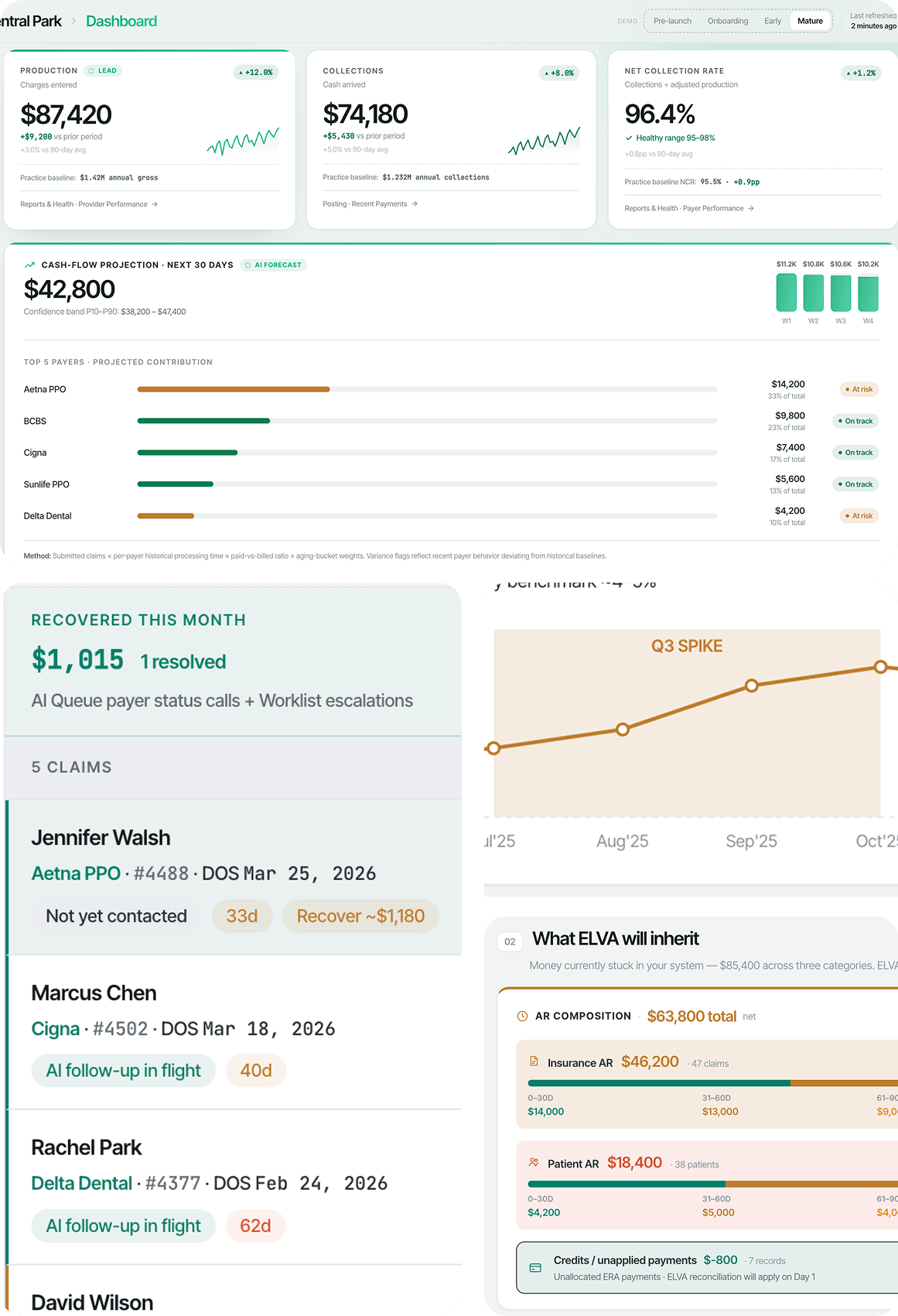
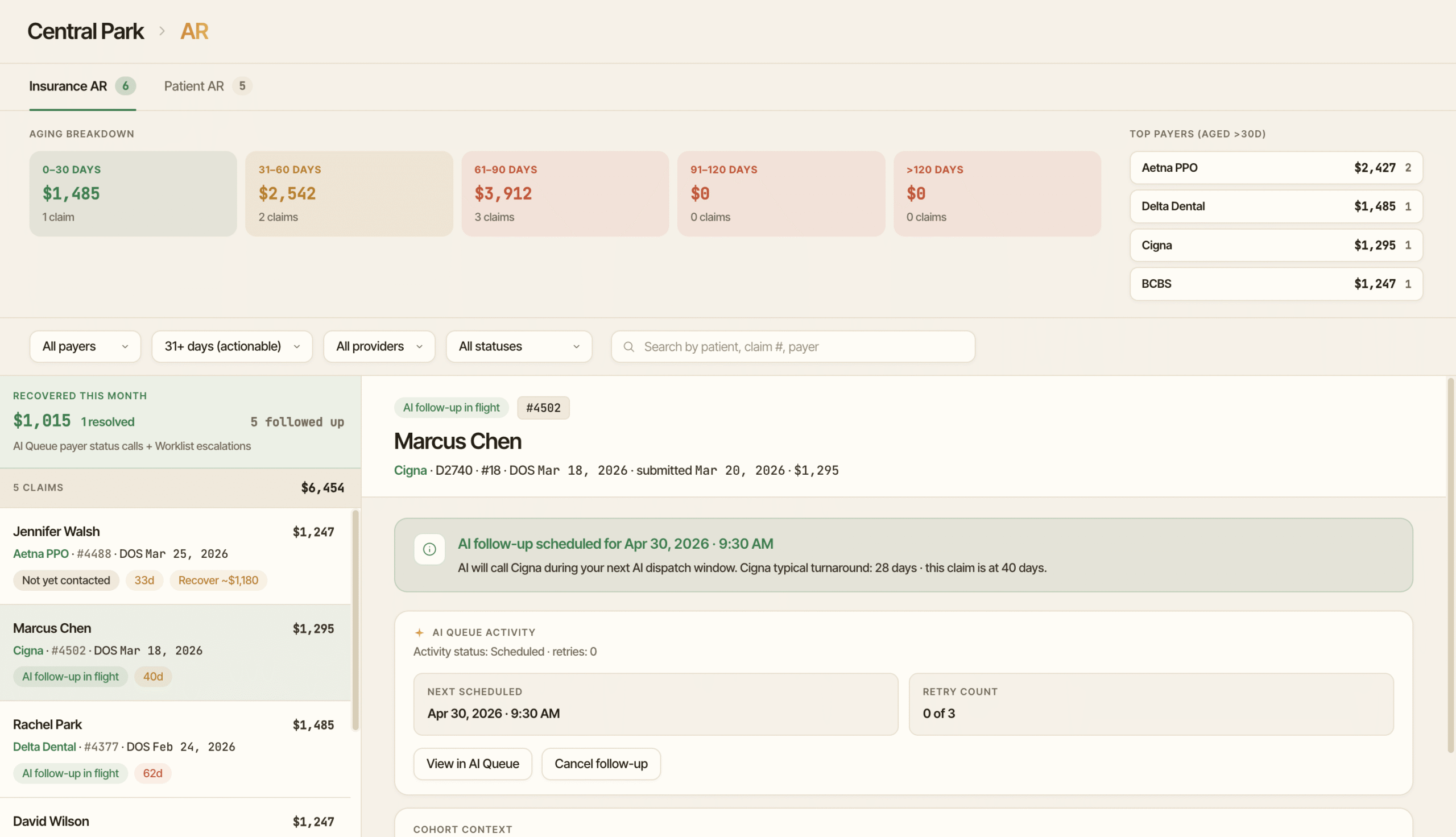
Elva keeps every outstanding balance visible by aging bucket — 30, 60, 90+ days — instead of buried in a report nobody opens.

2

Reconcile

Cross-references what's been paid against what's owed, flagging discrepancies and unexplained credits.

3

Surface

What needs action today is surfaced clearly, by payer and by balance, instead of left for someone to notice.

4

Follow Up

Drafts the payer follow-up or patient statement needed to move a balance forward — sent automatically or staged for review, depending on how your practice has Elva configured.

Tracked before it ages, not discovered in a spreadsheet three months later

Most practices don't lose AR revenue all at once. They lose it in small pieces — a balance nobody followed up on, a payer that never got chased, a credit that sat unexplained until nobody remembered why it was there.

Days Sales Outstanding (DSO) measures how long it takes a practice to collect payment after a claim is submitted — the lower the number, the faster revenue actually reaches the practice. Elva's job is to keep every balance visible enough that DSO stays low without anyone having to chase it manually.

Stop Watching Revenue Age Into a Write-Off

See how Elva keeps every balance visible and moving — before it crosses into uncollectible.

The AR Recovery Engine

A balance doesn't become uncollectible overnight — it ages there, 30 days at a time, while nobody follows up. Elva tracks every dollar by how long it's been outstanding and who owes it, so nothing crosses into write-off territory unnoticed.

Checking on the status of an unpaid claim is expensive when it's manual. Dental providers and staff spend an average of 18 minutes per inquiry checking claim status by phone — the single most time-consuming administrative task CAQH measures — and the dental industry could save an estimated $421 million annually by moving this work to automated tracking.

Source: CAQH Index 2024 Report, "From Transactions to Trust." Accessed Aug 17, 2026.

The Ghost Credit

The risk

A credit sits on a patient's ledger from an old overpayment or adjustment — nobody remembers why it's there, so it never gets resolved, refunded, or applied.

What Elva does

Flags unexplained credits and surfaces what created them, so your team can resolve them instead of letting them sit indefinitely.

The Balance Nobody's Chasing

The risk

A claim ages past 60, then 90 days because it's buried in a report nobody opens daily — by the time someone notices, the payer's own follow-up window has narrowed.

What Elva does

Surfaces every balance by aging bucket automatically, so a 90-day claim gets attention before it becomes a 120-day write-off.

Screenshot

A balance that ages past 90 days rarely resolves itself — it either gets chased or it gets written off. The Revenue Recovery Calculator estimates what's currently sitting in your aging AR.

Aging AR is where every other gap ends up

A balance in AR isn't usually a new problem — it's what's left after an eligibility gap, a claim error, or an unappealed denial goes unresolved. Elva tracks the balance back to where it started, instead of treating AR as a disconnected spreadsheet. Ask RCM Brain which balances are closest to aging into a write-off, right now.

How a practice gets paid matters too. By moving from paper checks to electronic funds transfer, the dental industry has already avoided spending $251 million annually — the largest savings of any administrative task CAQH measures.

Source: CAQH Index 2024 Report, "From Transactions to Trust." Accessed Aug 17, 2026.

Screenshot

Built to work with your PMS, not replace it

Elva runs alongside Dentrix, Dentrix Ascend, and Open Dental. Where the system supports it, balance and aging data sync directly to the ledger; where it doesn't, it's surfaced for fast entry.

Elva Eligibility engine
Two-way sync · Real-time
Authorized API Partner
Official API Vendor Partner
Systems supported Dentrix Dentrix Ascend + more

FAQ

What is DSO (Days Sales Outstanding) and why does it matter?

DSO measures how long it takes a practice to collect payment after a claim is submitted. A lower DSO means revenue is reaching the practice faster — a higher one usually means balances are sitting unattended.

Does Elva collect payments or write off balances automatically?

Yes — Elva can be configured to send follow-up automatically, or to draft everything and wait for your team's review first. You choose the level of oversight that fits your practice.

What's a "ghost credit" and why does it matter?

A ghost credit is a balance sitting on a patient's ledger — often from an old overpayment or adjustment — that nobody has resolved because nobody remembers why it's there. Left alone, it distorts the ledger and can represent real, unrefunded or unapplied money.

Does this work with my practice management system?

Elva works alongside Dentrix, Dentrix Ascend, and Open Dental. Where the system supports it, balance and aging data sync directly; where it doesn't, it's surfaced for fast entry.

Why is checking claim status so time-consuming without automation?

Dental providers and staff spend an average of 18 minutes per inquiry checking claim status by phone, per CAQH — the most time-consuming administrative task measured across the entire revenue cycle.

How does Elva decide which balances need attention first?

Elva surfaces balances by aging bucket and dollar amount, prioritizing what's closest to a payer's follow-up window or write-off threshold, so your team works the highest-risk balances first.

Ready to Stop Losing Revenue to Aging AR?

See Elva track every balance before it crosses into a write-off.