Your Revenue Cycle Is Leaking Where You Can't See It
One connected insurance layer — eligibility, claims, denials, and AR — that catches what's slipping through before it's gone for good. Works alongside your PMS.
seen
benefits
coverage
claim
remittance
follow-up
One engine reads and acts at every step — verify · decide · code · capture · appeal · collect
The pressure is real, and it's structural
Since January 2021, dental reimbursement rates have risen just 19% — inflation has run 27%. The gap hasn't closed.
Source: ADA Health Policy Institute, Q2 2026 Update
More than half of dentists now name insurance — low reimbursement, delayed or denied payments — as a top concern heading into 2026.
Source: ADA Health Policy Institute / ADA News, Jan 2026
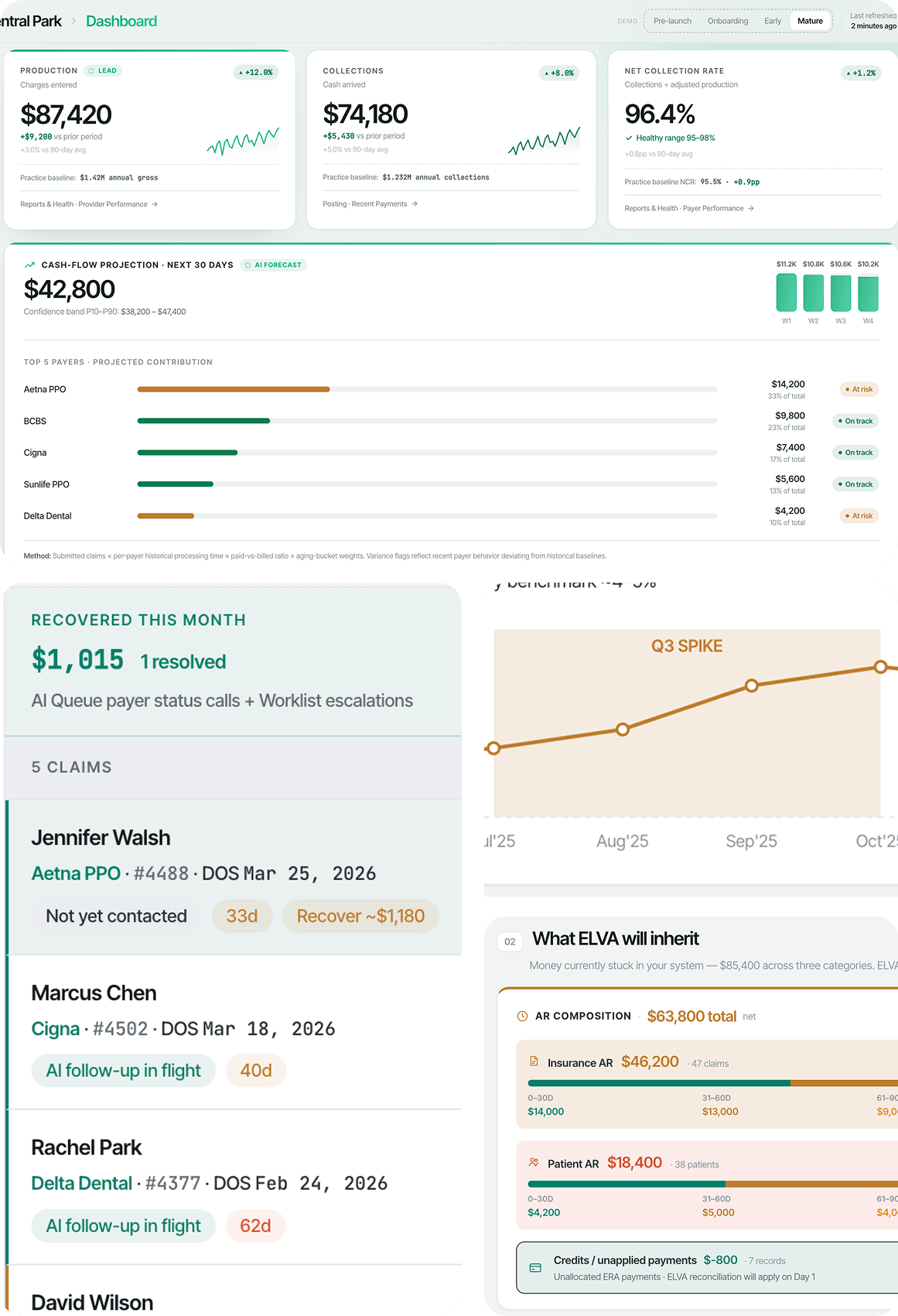
Practices don't lose this revenue in one big event. They lose it in a hundred small ones: an eligibility check nobody ran, a claim that went out with the wrong code, an underpayment caught too late to appeal, a balance that aged past 90 days while the front desk was on the phone. Elva is the insurance layer that closes those gaps — and every answer it gives traces back to where it came from.
Dental revenue cycle management is the full process of turning a scheduled visit into collected revenue — eligibility, claims, posting, denials, and AR — and it's where most front-office revenue leaks, because each stage hands off to the next and errors compound.
Where dental practices lose insurance revenue
Insurance revenue leaks at five predictable points, and most practices can't see them until the money is already gone:
Eligibility
coverage not verified before the visit, so the estimate is wrong and the claim is built on bad assumptions
Claims
coding errors, missing attachments, and payer-specific rules that turn a valid claim into a denial
Underpayments
payers reimbursing below the contracted rate, caught too late to appeal
Denials
claims rejected and never reworked, because nobody had time
Aging AR
balances sitting past 30, 60, 90 days while the team focuses on today's schedule
Elva addresses each of these as a connected system rather than five disconnected tools — which matters, because the leak at one stage is usually created at the one before it.
Verify insurance before the visit, not after
The cleanest claim is the one built on verified coverage. Elva checks eligibility ahead of the appointment and surfaces what the plan actually covers — so the treatment estimate is right the first time and the claim doesn't fail on an assumption nobody checked.
Submit clean claims and prepare prior authorizations
A clean claim is one that goes out coded correctly, with the right attachments, under the payer's specific rules — the first time. Elva prepares the claim, surfaces what's missing before it goes out, and drafts prior authorizations where the plan requires them. Nothing submits until your team signs off.
Catch underpayments and work denials while there's still time
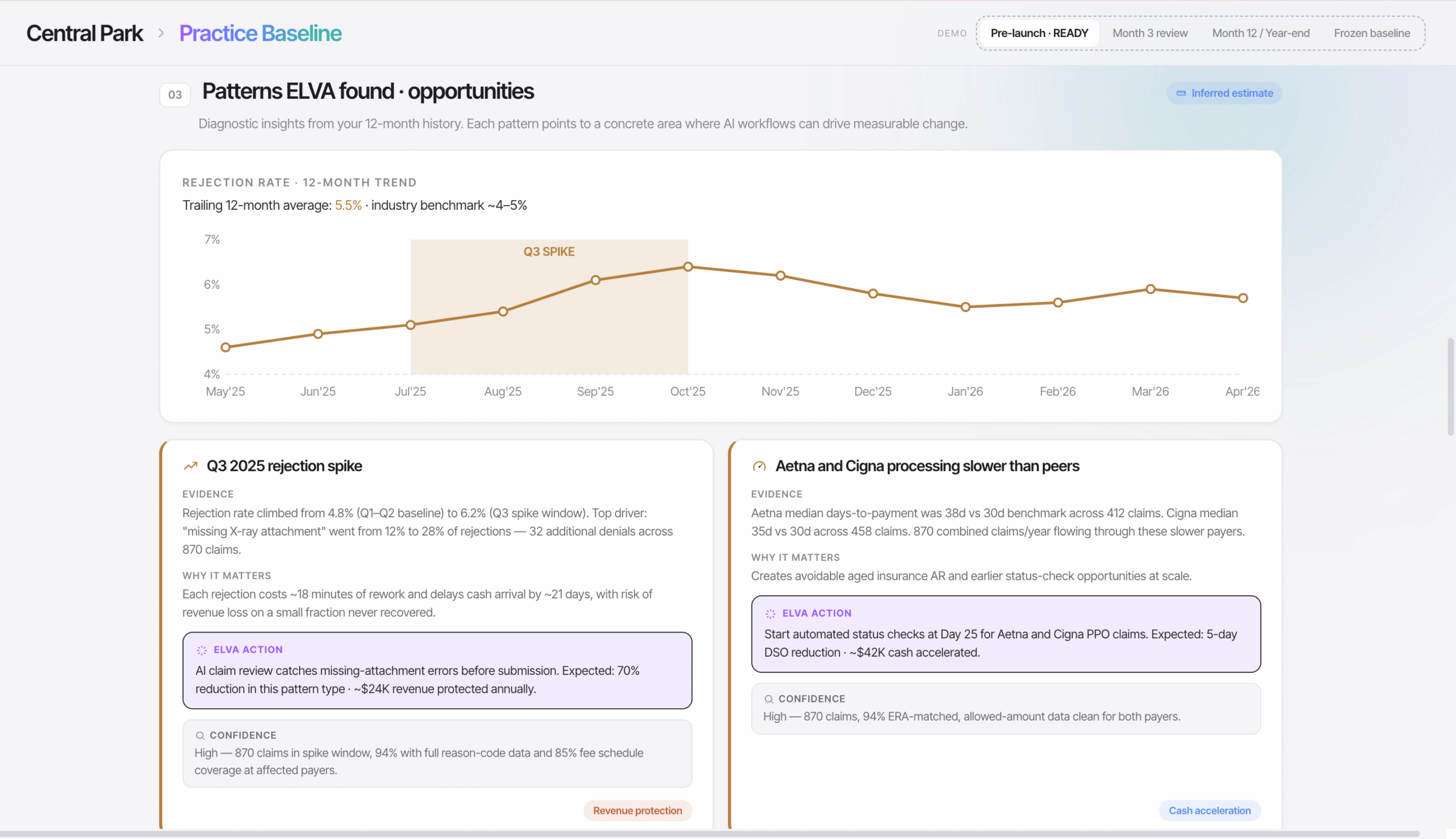
An underpayment caught after the appeal window is revenue lost for good. Elva reconciles what the payer paid against what the contract owes, flags the gap the moment it appears, and drafts the appeal so your team can review and send — not discover the shortfall months later in a spreadsheet.
The pressure here is structural, not incidental: downcoding and bundling — where a payer reclassifies or combines procedures to pay less — are common enough that in 2025 alone, 37 dental insurance reform laws passed across 18 states specifically to address downcoding, bundling, and payment practices, up from 16 laws in nine states the year before. When the practice can't see the downgrade, it can't appeal it.
Keep aging AR visible instead of buried
AR ages while the front desk is busy being the front desk. Elva keeps every outstanding balance visible by bucket — 30, 60, 90+ days — and surfaces what needs action today, so nothing quietly crosses the line into uncollectible.
Document Center — the paper side of insurance, digitized.
Roughly 10–15% of payers still run on paper: claims that must be printed and mailed, and checks and EOBs that arrive in the envelope and have to be read, interpreted, and keyed in by hand. That manual review is slow — and slow is expensive, because appeal windows are short and an underpayment caught too late is revenue lost for good.
Capture
Photograph a mailed check or EOB with the Elva app on an iPad or phone.
Extract
Elva identifies the document and pulls out the data — payer, amounts, adjustments, the full remittance.
Confirm
The extracted data is surfaced for a quick staff confirmation — designed for accuracy, with a human check as the safeguard.
Flag
The moment it's confirmed, Elva flags discrepancies — underpayments and incorrect amounts — while there's still time to appeal.
Ask your revenue cycle anything.
Every answer Elva produces is also a conversation you can have. Instead of digging through portals, ledgers, and EOBs, your team just asks — in plain language — and Elva answers from your own data and rules.
The whole revenue cycle, queryable — so a new biller is productive on day one, and the answer is always traceable to where it came from.
 Elva
On your data
Elva
On your data
Yes — D2740 was paid as D2750 (downgrade to PFM). Aetna applies an alternate-benefit clause on posterior crowns under this plan. We've seen the same pattern on 12 of your last 14 Aetna crown claims.
7 claims, $4,210 total. Three are awaiting payer response, two need a corrected resubmission, and two have appeals drafted and ready for your review.
See what this could recover for your practice
Every insurance gap on this page — an eligibility check missed, a claim denied, a balance that aged too long — adds up to a real number specific to your practice size and claim mix.
Built to work with your PMS, not replace it
Elva runs alongside Dentrix, Dentrix Ascend, and Open Dental. Where your system allows Elva to post directly, it does; where it doesn't, Elva surfaces the data to the ledger for fast entry. The standard insurance layer is PMS-independent; integration depth varies by system.
 Authorized API Partner
 Official API Vendor Partner
FAQ
What is dental revenue cycle management?
Dental revenue cycle management is the full process of turning a scheduled visit into collected revenue — verifying eligibility, submitting claims, posting payments, working denials, and clearing accounts receivable. Most front-office revenue leaks happen somewhere in that chain.
How does Elva reduce claim denials?
Elva prepares claims coded correctly and surfaces missing attachments or payer-rule problems before the claim goes out, so fewer are rejected — and drafts appeals on the ones that are, while there's still time to act. Downcoding and bundling are common enough that 37 state reform laws passed in 2025 to address them; Elva's job is to catch those adjustments while the appeal window is still open.
Does Elva submit claims automatically?
Yes — Elva can be configured to submit claims fully automatically, or to prepare everything and wait for your team's review before anything goes out. You choose the level of oversight that fits your practice.
Does Elva work with my practice management system?
Elva works alongside Dentrix, Dentrix Ascend, and Open Dental. Where the system supports direct posting, Elva posts; where it doesn't, it surfaces the data to the ledger. Integration depth varies by PMS.
What happens with payers that still use paper?
Elva's Document Center captures mailed checks and EOBs by photo, extracts the remittance data for staff confirmation, and flags underpayments — and prepares ready-to-submit packages for payers that require paper.
See where your revenue cycle is leaking
One connected insurance layer — eligibility, claims, denials, and AR — working alongside your PMS. Talk to us about what's slipping through in yours.