RCM Brain: Ask Your Revenue Cycle Anything | Elva
ElvaAI Free Consultation
Elva AI
Free AI Readiness Consultation
InsuranceAsk Your Revenue Cycle Anything

Turn Every System Into One Sourced Answer

Ask your revenue cycle anything — Elva answers from your claim history, payer rules, and live ledger

Plain-language queries
Sourced, traceable answers
Cross-system search
Live ledger access
Screenshot

How it works

1

Ask

Your team asks a question in plain language, the way they'd ask a colleague — no report to build, no portal to log into.

2

Retrieve

Elva pulls from claim history, payer policy, and the live ledger — not a static report that's already out of date.

3

Answer

The answer comes back specific and readable, not a data dump someone has to interpret.

4

Trace

Every answer shows its source — the claim, the policy, the ledger entry — so it can be checked, not just trusted.

The answer usually exists somewhere. Finding it is the actual cost.

The answer to a billing question is almost always already sitting in a payer portal, a claim history, or a spreadsheet someone built two years ago. Finding it is the real cost — minutes per question, repeated across every staff member who doesn't know exactly where to look.

RCM Brain is a plain-language interface into the whole revenue cycle — claim history, payer policy, and live AR — that answers in seconds instead of a search across systems, and always shows the source behind the answer.

Stop Searching, Start Asking

See RCM Brain answer a real question, sourced to a real claim.

Three Sources, One Trusted Answer

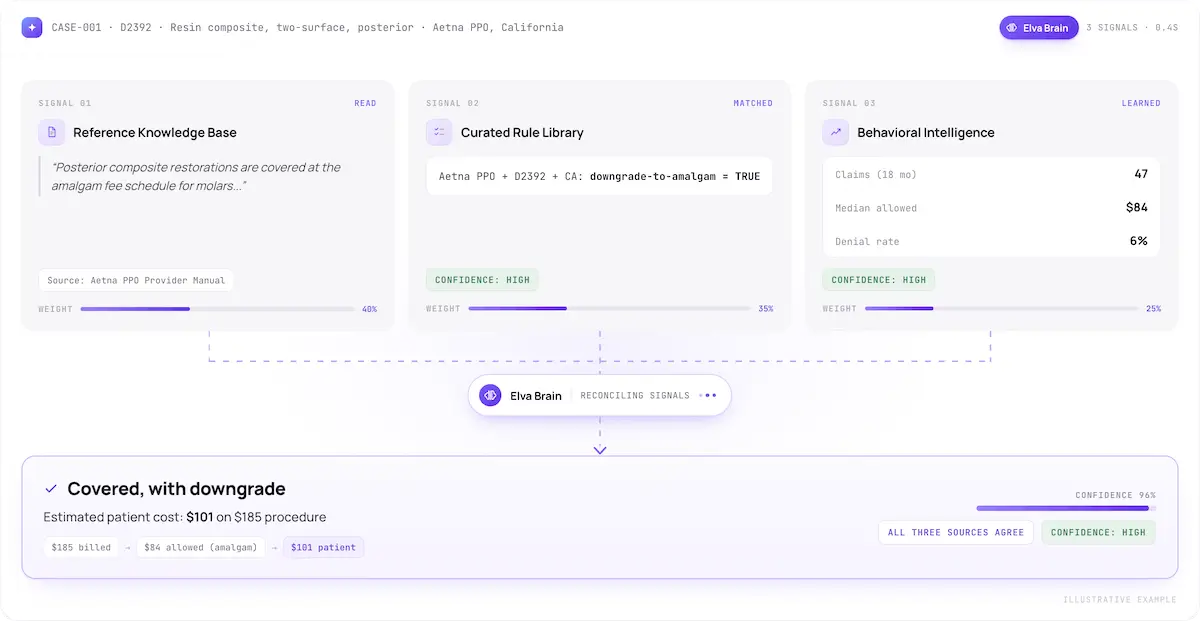
Ask a coverage question, and the answer isn't a guess from one source. RCM Brain checks it against what the payer has actually published, what your own claim history to that payer shows, and expert-curated knowledge of how that payer behaves — and tells you when those sources agree or disagree, instead of picking one and hoping.

RCM Brain cross-references 700+ payer-specific rules — and growing — against ~5,000 reference documents, including provider manuals, bulletins, and published payer policy, so an answer is checked against what payers have actually said, not just what's plausible.

Source: Elva's Reference Knowledge Base and Curated Rule Library, current as of Aug 2026. Both expand continuously.

The Downgrade the Manual Doesn't Warn You About

The risk

Aetna PPO's published policy says posterior composite fillings are covered — but on molars, the actual claim gets downgraded to the amalgam fee, and the patient owes the difference. A policy lookup alone would say "$0 out of pocket." Real claims say otherwise.

What Elva does

Checks the published policy against this clinic's actual claim history for the same procedure and payer — recent claims show a consistent downgrade pattern — and gives the front desk a real number before the patient leaves the chair: covered, with downgrade, an estimated $101 out of pocket on a $185 procedure.

The Rule That Went Stale

The risk

A billing rule that was accurate last quarter can go stale the moment a plan changes or a network renegotiates — and nobody notices until a clean-looking claim comes back denied.

What Elva does

Checks curated rules against what's actually happening in current claims, so a rule that's drifted out of date gets flagged instead of trusted blindly.

Screenshot

A downgrade like this is easy to miss and expensive to eat, one claim at a time. The Revenue Recovery Calculator estimates what patterns like this are costing your practice.

One question box, the whole revenue cycle behind it

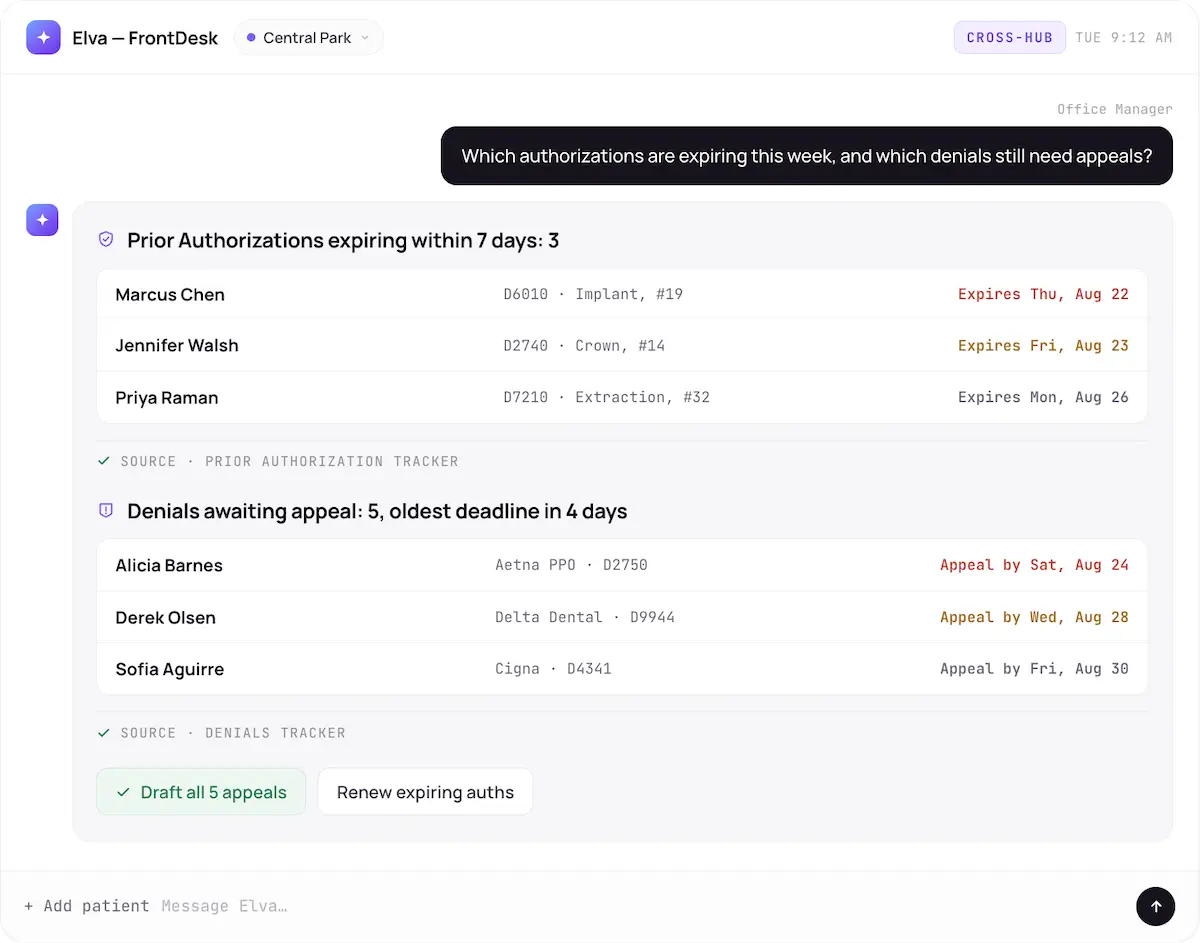
RCM Brain isn't a separate tool bolted onto the revenue cycle — it's the same system that checks eligibility, prepares claims, catches denials, and tracks aging AR, answering questions about all of it at once. Ask which claims are sitting past 90 days, which payers owe the most, or why a specific claim was denied — and get an answer sourced to the actual record, not a guess.

AI adoption in dental practices is already real, not theoretical. In Q2 2026, 43.3% of dentists reported using AI for at least one task in their practice — and outside of treatment recommendations, the fastest-growing categories are exactly the administrative and RCM tasks RCM Brain touches: insurance verification, billing, and charting.

Source: ADA Health Policy Institute, "The State of the U.S. Dental Economy," Q2 2026 Update. Accessed Aug 17, 2026.

Screenshot

Built to work with your PMS, not replace it

Elva runs alongside Dentrix, Dentrix Ascend, and Open Dental. RCM Brain answers from whichever system holds the data — the PMS, the payer connection, or Elva's own tracking — without your team needing to know which one to check.

Elva Eligibility engine
Two-way sync · Real-time
Authorized API Partner
Official API Vendor Partner
Systems supported Dentrix Dentrix Ascend + more

FAQ

What is RCM Brain?

RCM Brain is a plain-language interface into your revenue cycle — ask a question about a claim, a payer, or an outstanding balance, and get a sourced answer from your own claim history, payer rules, and live ledger.

Does RCM Brain make decisions or take action on its own?

RCM Brain itself only answers questions — it doesn't submit claims or send appeals on its own. The tools it draws from (claims, appeals, follow-up) can be configured to run fully automatically or to wait for your team's review, depending on your practice's settings.

How is RCM Brain different from a report or dashboard?

A report shows what someone thought to build in advance. RCM Brain answers the specific question you're asking right now, in plain language, pulled live from the actual record — and shows you where the answer came from.

Can new staff use RCM Brain without training on every system?

Yes — that's one of the main points. RCM Brain puts the whole revenue cycle behind one question box, so a new hire doesn't need to know which system holds which answer.

Does this work with my practice management system?

Elva works alongside Dentrix, Dentrix Ascend, and Open Dental. RCM Brain draws from whichever system holds the relevant data, regardless of which PMS a practice runs.

How does RCM Brain source its answers?

Every answer draws from three sources: what the payer has published (provider manuals and policy bulletins), what your own claim history to that payer actually shows, and expert-curated knowledge of payer-specific behavior. When these sources agree, confidence is high; when they don't, the disagreement is flagged for your team instead of guessed at. RCM Brain only learns from what actually happened — a paid claim, a denied claim, a confirmed correction — never from its own past suggestions.


Ready to Stop Searching and Start Asking?

See RCM Brain answer a real question, sourced to a real claim.