Dental Prior Authorization Software | Elva
ElvaAI Free Consultation
Elva AI
Free AI Readiness Consultation
InsuranceProactive Prior Authorization

Get the Right Approval Before It Costs You a Denial

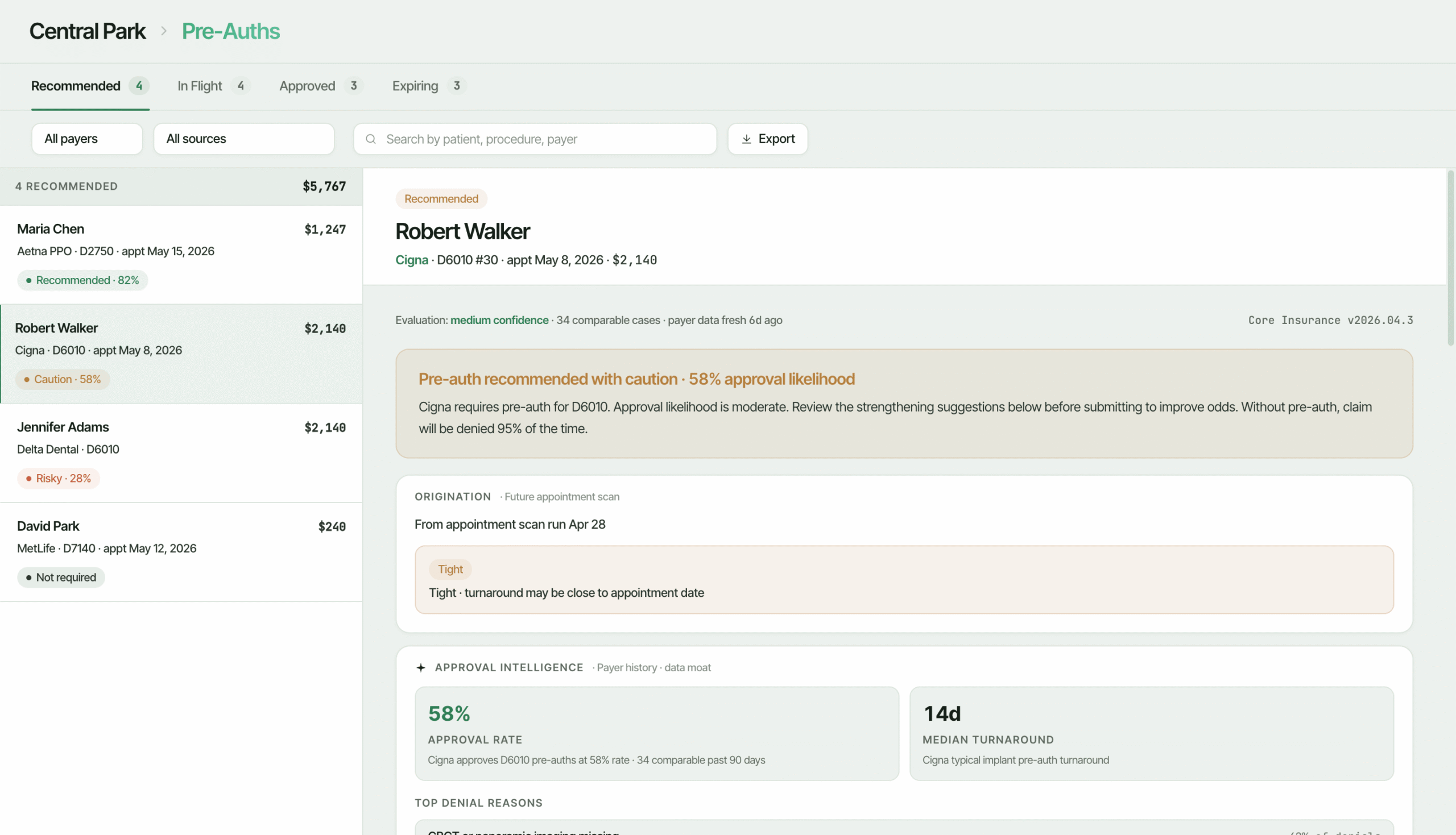
Elva tracks which procedures need authorization and drafts the request — before treatment, before the window closes

Authorization requirement checks
Predetermination vs. PA detection
Expiration tracking
Payer-deadline alerts
Screenshot

How it works

1

Identify

Elva flags which planned procedures require prior authorization based on the specific payer and plan.

2

Draft

The correct request — prior authorization, not a predetermination, where one is required — is prepared with the supporting documentation the payer expects.

3

Track

Every submitted request is tracked against its own expiration window, not a generic assumption. Timelines vary widely by payer — some review in three business days, others take much longer — so Elva tracks each request against its specific payer's actual timeline.

4

Flag

If an authorization is about to expire before the procedure is scheduled, or a claim risk appears despite approval, Elva surfaces it before it becomes a denial.

Tracked from the moment it's needed, not discovered when it's too late

Some procedures can't be scheduled without approval first — implants, oral surgery, orthodontics, periodontal surgery, and others, depending on the payer and plan. Miss that a procedure needs authorization, or submit the wrong kind of request, and the claim denies later regardless of how appropriate the treatment was.

A prior authorization and a predetermination are not the same thing, and payers treat them differently. A prior authorization is typically a binding coverage decision; a predetermination is a non-binding estimate. Submit the wrong one, and the claim can deny even after a favorable "approval." Elva tracks which one a procedure actually requires — not which one is easiest to submit.

Stop Losing Approved Treatment to Paperwork

See how Elva tracks authorization requirements, deadlines, and the right form — before a denial happens.

The Approval Tracking Engine

Prior authorization isn't a single step — it's a set of payer-specific rules about what needs approval, which form to use, and how long that approval lasts. Getting any one of those wrong turns an approved treatment plan into a denied claim.

Even an approved authorization isn't the end of the risk. Per the American Dental Association, a claim can still be denied after pre-authorization if the patient's eligibility changes, the plan's annual maximum has already been reached, or a time limitation has passed between authorization and treatment — a preauthorization is not a guarantee of payment. Elva checks eligibility again close to the date of service, not just on the day the authorization was requested, so a gap like this gets caught before the claim goes out.

Source: American Dental Association, "Pre-Authorizations." Accessed Aug 17, 2026.

Predetermination vs. Prior Authorization

The risk

A biller submits a predetermination — a non-binding coverage estimate — when the plan actually required a binding prior authorization. The claim denies later, even though the "estimate" came back favorable.

What Elva does

Flags which procedure-payer combinations require a true prior authorization versus a predetermination, and drafts the correct one from the start.

Authorization Expiration

The risk

A procedure is approved, but isn't scheduled before the authorization's own expiration window closes — so the "approved" treatment now needs an entirely new request, delaying care.

What Elva does

Tracks each authorization's expiration date against the scheduled appointment and flags it before the window closes.

Screenshot

A treatment plan delayed by a paperwork mistake doesn't just cost time — it delays revenue and can delay patient care. The Revenue Recovery Calculator estimates what authorization delays are costing your practice.

Prior authorization feeds the whole revenue cycle

Prior authorization depends on knowing what the plan actually covers in the first place, and it feeds directly into the claim that goes out once treatment is complete. If a claim comes back denied despite a valid authorization, Elva catches it and drafts the appeal instead of letting it sit. Ask RCM Brain which authorizations are about to expire, right now.

This isn't just an administrative inconvenience — it's significant enough that states have begun legislating it directly. Louisiana law, for example, prohibits payers from denying a claim for a previously authorized procedure except under specific, narrow circumstances.

Source: Louisiana State Legislature, Act 208 (HB 429), 2018. Accessed Aug 17, 2026.

Screenshot

Built to work with your PMS, not replace it

Elva runs alongside Dentrix, Dentrix Ascend, and Open Dental. Where the system supports it, authorization status and expiration dates sync to the patient record; where it doesn't, they're surfaced for fast entry.

Elva Eligibility engine
Two-way sync · Real-time
Authorized API Partner
Official API Vendor Partner
Systems supported Dentrix Dentrix Ascend + more

FAQ

What's the difference between a prior authorization and a predetermination?

A prior authorization is typically a binding coverage decision from the payer before treatment. A predetermination is a non-binding estimate of what the plan would likely cover. Submitting the wrong one for a given procedure can lead to a denial even after a favorable response.

Does a prior authorization guarantee my claim will be paid?

No. Per the American Dental Association, a claim can still be denied after authorization if the patient's eligibility changes, the annual maximum is reached, or a time limit passes before treatment. Prior authorization is not a payment guarantee.

Does Elva submit prior authorization requests automatically?

Yes — Elva can be configured to submit requests fully automatically, or to draft everything and wait for your team's review before it's sent. You choose the level of oversight that fits your practice.

Does this work with my practice management system?

Elva works alongside Dentrix, Dentrix Ascend, and Open Dental. Where the system supports it, authorization data syncs to the patient record; where it doesn't, it's surfaced for fast entry.

Why does prior authorization timing matter so much?

Approval windows vary by payer — some take just a few business days, others longer, and every authorization has its own expiration. Missing either can turn an approved treatment plan into a denied claim or a delayed patient.

Which procedures typically require prior authorization?

Requirements vary by payer and plan, but prior authorization is commonly required for procedures like implants, oral surgery, orthodontics, periodontal surgery, sedation, and certain endodontic treatments.

Ready to Stop Losing Approvals to Paperwork?

See Elva track authorization deadlines and requirements before they become a denial.