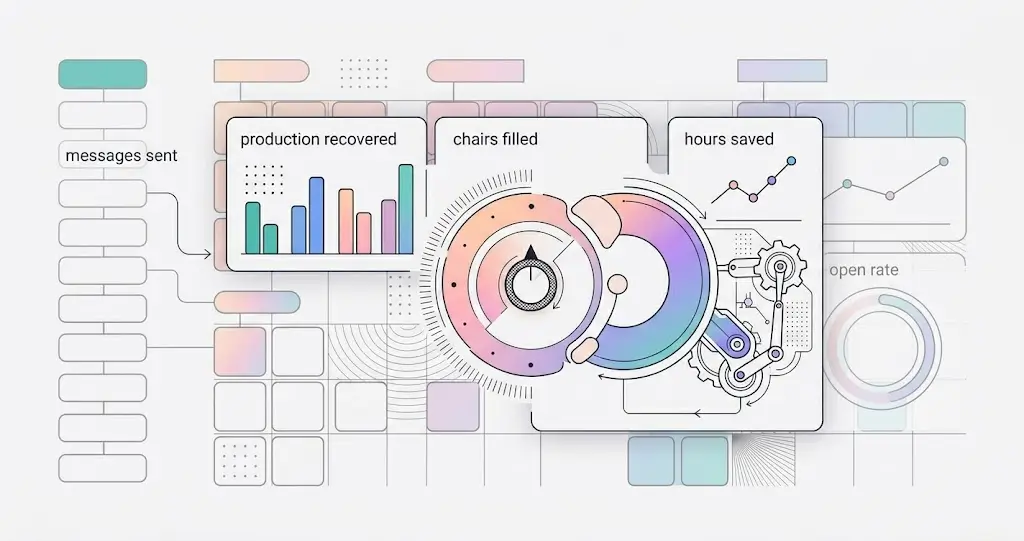
Open the recall report in most dental software and here’s what it shows you: messages sent, messages delivered, open rate, maybe confirmations captured. Every number describes the tool’s activity, not your practice’s result. It tells you the software did something — not whether a chair got filled, a balance got paid, or a lapsed patient came back. Useful dental recall reporting answers the only two questions an owner actually asks at month-end: how much money did this bring back, and how much staff time did it give me? Almost nothing in the category answers either.
That’s not a small reporting-design quibble. It’s the difference between a tool you’re hoping helps and a system you can manage to a number. You can’t optimize what you can’t measure in the units that matter, and “1,400 texts sent, 38% open rate” isn’t a unit that matters to anyone who signs the checks.
Dental Recall Reporting: The Outcomes ELVA Reports Instead
Every recall in ELVA is tied to one of eight goals, and each goal is measured against the real business or clinical result it’s trying to produce — not the message that carried it.
- Book — bookings, attendance rate, revenue generated, cost per booking.
- Confirm — confirmation rate, no-show rate of confirmed appointments, chair-hours saved, share auto-confirmed without staff.
- Collect — amount collected, collection rate, average days to payment, payment plans created.
- Schedule treatment — treatment scheduled %, production recovered, pending dollars remaining, financing utilization.
- Reactivate — reactivation rate, patients recovered, lifetime value recovered, offer-redemption rate.
- Clinical safety — response rate, concerning answers flagged to staff, average reported pain score, time to first response.
- Info collection — completion rate, forms collected, staff hours saved, average time to complete.
- Engagement — engagement rate, referrals generated, referral conversion, revenue from referrals.
Read that list against a typical recall report and the shift is obvious: production recovered, chairs filled, lifetime value reactivated, staff hours saved, balances collected. These are the words an owner repeats to their accountant — and the words a “messages sent” report can never produce, because it was never measuring them.
Why Dental Recall Reporting on Outcomes Changes the Behavior
When a recall is tied to dollars recovered rather than texts sent, two things change. You can tell which programs actually earn their place — the reactivation program that recovers real lifetime value stays; the one that just generates open-rate doesn’t get to hide behind a vanity metric. And you can make the case for recall in the language of the practice’s P&L, because the report already speaks it. A recall report that ends in “production recovered” is a report you can take into a budget conversation — the same way you’d prove dental AI ROI for any investment; one that ends in “open rate” is one you have to translate and hope.
One outcome on that list isn’t financial at all, and it matters most: the clinical-safety goal tracks response rates and concerning answers flagged to staff, from post-operative dental follow-up from programs like post-operative follow-up. That’s recall measured as patient safety — a number no “messages sent” report would ever think to surface.
For a group, the report is the management layer
At a single practice, outcome reporting is clarity. Across a group, it’s control. A DSO operator can’t walk every floor, and a recall report measured in “messages sent” is worse than useless across twenty locations — it tells you the tools are running, not whether production is being recovered anywhere in particular. Outcome reporting in dollars and chair-hours is the same instrument that makes the rest of a multi-location group manageable: a current, comparable view of what’s actually being recovered, by location, in units that roll up. It’s the recall half of the broader problem of DSO real-time visibility — and it ties directly to growing a dental group without overhead.
Recall only produces those outcomes if the right patients are reached at the right moment — which is what dental patient segmentation and automated recall management system do, and where the numbers above come from — see how it all fits together in reminders vs. a recall engine.
Frequently Asked Questions
What should a dental recall report actually measure?
The outcomes an owner cares about, not the tool’s activity: production recovered, chairs filled, lifetime value reactivated, balances collected, and staff hours saved — rather than messages sent, delivered, and opened. ELVA ties every recall to one of eight goals and reports each against its real business or clinical result.
Why are “messages sent” and “open rate” considered vanity metrics?
Because they describe what the software did, not what the practice gained. A high open rate doesn’t tell you whether a chair was filled or a balance was paid. They’re easy to report and easy to look good on, which is exactly why they don’t belong at the center of a recall report.
What are the eight recall goals ELVA measures?
Book, Confirm, Collect, Schedule treatment, Reactivate, Clinical safety, Info collection, and Engagement — each with its own outcome metrics, from revenue generated and chair-hours saved to lifetime value recovered and concerning answers flagged to staff.
How does outcome reporting help a multi-location group?
It turns recall into a management layer. Across many locations, a “messages sent” report tells you nothing actionable; outcome reporting in dollars and chair-hours gives a current, comparable view of what’s being recovered by location — the same real-time visibility that makes the rest of a group manageable.
Can recall reporting include clinical outcomes, not just financial ones?
Yes. The clinical-safety goal tracks response rates, average reported pain scores, and concerning answers flagged to staff from programs like post-operative follow-up — recall measured as patient safety, which financial-only reporting never surfaces.
Measure recall in dollars and chairs. See AI-assisted recall software, powered by ELVA’s AI brain for dental practices.