When a patient walks out without scheduling the crown, the deep cleaning, or the implant consult, the chart says “declined” — but that’s almost never what happened. The patient didn’t weigh the clinical evidence and reject it. Something between the diagnosis and the calendar got in the way, and “I’ll think about it” was the polite exit. Understanding why patients decline dental treatment is the whole game, because every real reason turns out to be something a practice can fix.
Industry benchmarks make the stakes plain: existing patients accept roughly 40–50% of recommended treatment on average, and new patients only 25–35% — while strong practices run far higher. The difference isn’t better patients. It’s less friction. Here are the five frictions that actually kill cases.
Why Patients Decline Dental Treatment: The Five Reasons Cases Die
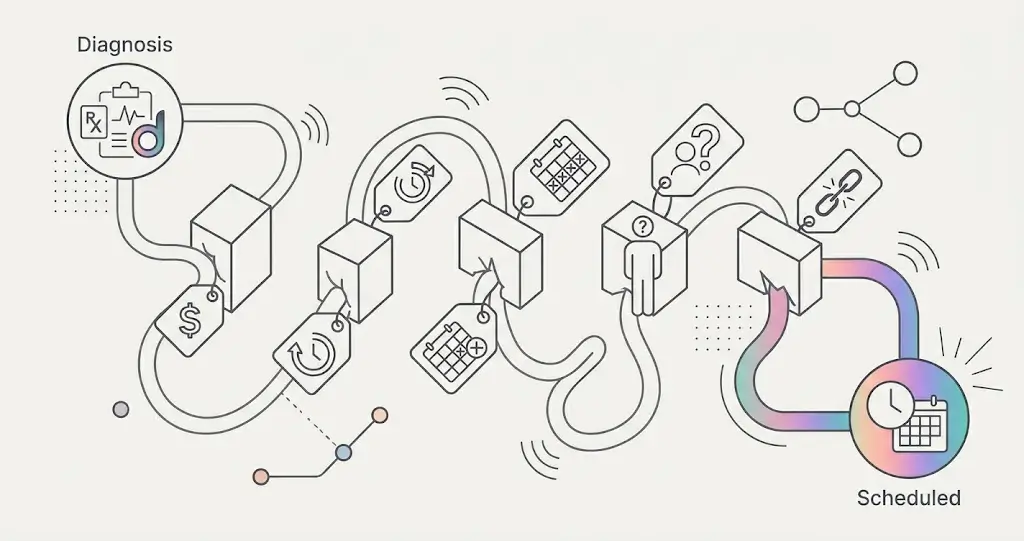
- They don’t understand what they’re saying yes to. The plan was clinical, fast, and confusing — codes and tooth numbers instead of a plain story. Nobody schedules what they can’t explain to their spouse at dinner.
- They don’t know what it will cost them. “We’ll have to check with your insurance” plants doubt, and doubt becomes delay. Cost uncertainty is the single biggest case-killer — industry surveys consistently rank cost worry as the top reason patients hold back.
- They don’t feel the urgency. “It doesn’t hurt right now” beats “you should do this eventually” every time — especially for asymptomatic conditions, where the consequence of waiting is invisible unless someone makes it visible.
- They felt pressured. Pressure makes people retreat. A patient who senses a sales push protects themselves the only way they can: by leaving without committing.
- They meant to schedule and forgot. The most preventable loss of all — a genuine “yes, soon” that nobody followed up on in a way that reached them, until “soon” quietly became never.
Notice what’s not on the list
“The patient doesn’t care about their health” isn’t there. “The patient can’t be convinced” isn’t there. In the overwhelming majority of stalled cases, the patient walked in trusting the dentist enough to sit in the chair — the trust already exists. What’s missing is information and timing: a plan they understand, a number they believe, a reason to act now, and a follow-up that arrives before life buries the intention.
That reframe matters because it changes whose problem this is. If patients decline because they’re unconvincible, the practice is helpless. If they decline because of confusion, cost-doubt, invisible urgency, pressure, and dropped follow-up — the practice owns all five.
Why Patients Decline Dental Treatment: Five Frictions, Five Fixes
This is exactly how ELVA’s AI brain for dental practices approaches the case journey: not one persuasion moment, but five specific frictions, each removed at its source. The team walks in prepared with the whole picture, the patient gets an honest per-procedure number instead of “we’ll check,” the cost of waiting is laid out plainly, the plan arrives on their phone to review without a salesperson watching, and the genuine “not yet” gets a follow-up written for that specific person. No pressure anywhere in the chain — because pressure is friction #4, and a system that adds it is working against itself.
The full picture of how those pieces compound is in dental case acceptance rate as a system; the mechanics live on the AI treatment plan follow-up page.
Frequently Asked Questions
Why do patients decline dental treatment?
Five frictions account for most stalled cases: the patient didn’t understand the plan, never got a believable number for the cost, didn’t feel any urgency (“it doesn’t hurt yet”), felt pressured, or genuinely intended to schedule and was never followed up with effectively. Genuine rejection of needed care is the rare case, not the common one.
Is cost the main reason patients say no to treatment?
Cost uncertainty more than cost itself. Industry surveys consistently rank affordability worry at the top — but the case usually dies at “we’ll have to check with your insurance,” not at a real number. A clear, honest estimate converts far better than a vague reassurance, even when the number is significant.
How does asymptomatic treatment affect acceptance?
It’s where acceptance drops hardest, because the consequence of waiting is invisible. A condition that doesn’t hurt yet feels like permission to wait — unless the practice makes the clinical and financial cost of delay plainly visible, in honest language rather than fear.
Does following up actually recover declined treatment?
Most “declined” treatment was never a hard no — it was a soft “not yet” that aged into never because follow-up was generic or absent. Personalized, well-timed follow-up that references the patient’s specific treatment and situation recovers a meaningful share of those cases.
How is removing friction different from sales training?
Sales training works on the persuader; friction removal works on the reasons the patient hesitates. Clarity about the plan, an honest cost number, visible urgency, zero pressure, and reliable follow-up — patients say yes because the obstacles are gone, not because someone closed harder.
Fix the frictions, not the patient. See the whole engine in dental case acceptance rate as a system.