On this page
In-house dental billing keeps claims, posting and follow-up with your own team, who know your patients. Outsourced dental billing hands that work to an outside company with dedicated billers. In-house fits a practice with a trained person and cover for when they are out. Outsourcing fits a practice that cannot hire or keep that person. A third option, software that does the repetitive work inside your own practice system, now sits between the two.
Many of the comparisons of in-house vs outsourced dental billing that you will find are written by billing companies. This one lays out what each option really changes, what to count before you decide, and what to ask before you sign.
What each option means
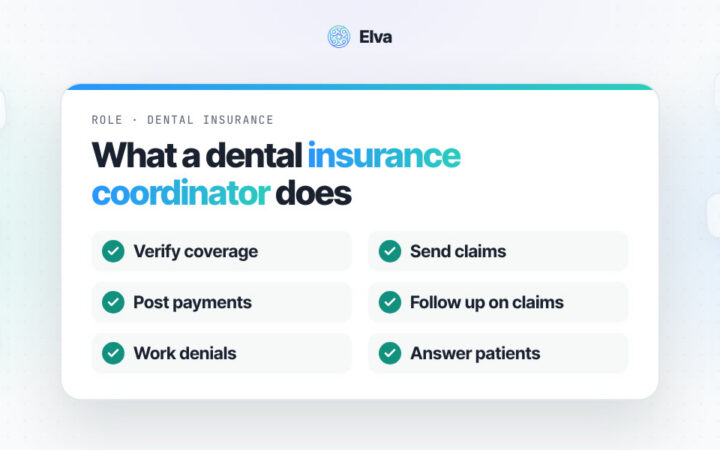
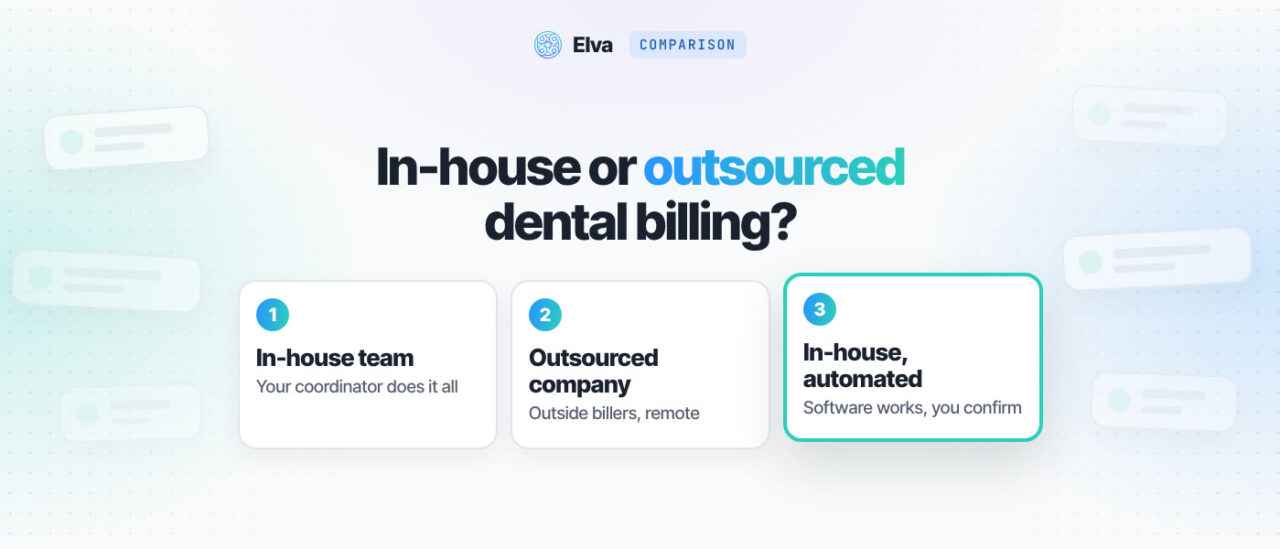
- In-house billing. An insurance coordinator or office manager on your payroll verifies coverage, sends claims, posts payments, follows up on unpaid claims and works denials.
- Outsourced billing. A third-party billing company does some or all of that work remotely, usually by signing in to your practice system. Your team still collects from patients and sends the company what it needs.
- In-house with automation. Software does the repetitive steps inside your practice system, and your team confirms the work and makes the judgment calls.
In-house vs outsourced dental billing at a glance
| Factor | In-house team | Outsourced billing company | In-house with automation |
|---|---|---|---|
| Who does the work | Your coordinator | The company’s billers | Software, with your team confirming |
| Knows your patients and treatment | Yes | No, it works from what you send | Works from your practice system and your claim history |
| When someone is out or leaves | Work slows or stops | The company covers its own staff | Work continues |
| What you can see | Everything, if you know where to look | What the company reports | Each step, logged |
| Patient data | Stays in the practice | Shared with the company | Shared with the software vendor |
| What your team still does | All of it | Patient collections, and checking what goes to the company | Confirming, and the judgment calls |
When in-house billing fits
The American Association of Dental Office Management (AADOM) has published a comparison by a long-serving office manager, and its case for in-house billing rests on four things:1
- Control. Your own person can watch every claim and add information when a payer asks for it.
- Communication. They can explain coverage to the team and answer patients’ questions about their plans.
- Cost. An in-house person may be more cost-effective, especially in a smaller practice.
- Patient knowledge. They know the patient and the treatment, so errors are caught before the claim is sent.
The weak point is that all of it depends on one person. Billing is hard to learn, and it is hardest to teach during staff turnover. If you have read about what happens when your dental biller leaves, you know how much payer knowledge can walk out with them.
When outsourced billing fits
The same AADOM article gives four reasons to outsource:1
- Expertise. Dedicated billers know insurance rules and policies.
- Team focus. Your staff spend their time on patients, not paperwork.
- Capacity. A billing company is set up to handle volume.
- Compliance. It keeps up with changing regulations.
It also adds a caution: you still need people in the office who check that what goes to the billing company is accurate.1 Outside billers work from what they are given. They were not in the room for the treatment plan.
What to count before you decide
Skip the industry averages and count your own practice:
- Hours. How many staff hours a week go to verification, claims, posting, follow-up and denials?
- Days to post. How long after a payment arrives is it posted? A denial is only found when the payment is read.
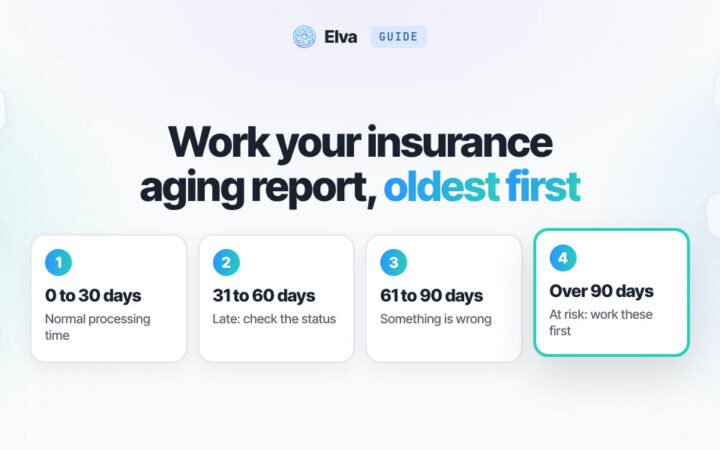
- Old claims. How much of your insurance money has been unpaid for more than 90 days?
- Cover. What happens to that work when your coordinator is away for two weeks?
Whichever route you choose, doing each step electronically costs less than doing it by hand. In the 2024 CAQH Index, dental providers reported an average cost of $12.01 for a claim status inquiry handled by hand and $3.71 for an electronic one, and $3.70 against $1.73 for a remittance advice.2
Patient data and the business associate agreement
A billing company handles your patients’ health information, and so does a software vendor. Under HIPAA that makes each of them a business associate. The American Dental Association’s tip sheet says a practice must have a business associate agreement with its business associates, and that business associates must have similar agreements with their own subcontractors.3 Ask for the agreement before any patient data is shared, and ask who else will handle the data.
Questions to ask a dental billing company
- Which parts of the work do you do, and which stay with my team?
- How soon after a payment arrives do you post it?
- Who works my denials and appeals, and how will I see what was done?
- What do you need from my office each day?
- Who has access to my practice system, and from where?
- Will you sign a business associate agreement, and do your subcontractors have one?
- What happens to my data and my open claims if we part ways?
The third option: keep billing in-house and automate it
The choice used to be between paying for a person and paying for a company. Software now does much of the repetitive work inside the practice system your team already uses.
That is how Elva works. It reads the insurance payments that arrive in your practice system and posts them, follows up on claims that have gone quiet, and works out the next step for each denied or short-paid claim. Your team confirms each one until you decide Elva can act on its own, and anything Elva cannot settle comes to your team with every try shown. Elva’s team does the setup, and Elva signs a business associate agreement with every practice. Your clearinghouse stays as it is.
You keep what in-house billing gives you: the work stays in your system, where you can see it. And you are no longer dependent on one person’s memory. See Elva’s dental RCM software.
How to decide
- You have a trained coordinator and someone who can cover them: stay in-house, and look at automation to take the repetitive work off them.
- You cannot hire or keep a coordinator, and your claims are already behind: outsourcing gets the work done, as long as someone in the office still checks what is sent.
- You want the work in your own system without depending on one person: in-house with automation.
FAQ
Is it better to outsource dental billing or keep it in-house?
It depends on your staffing. In-house billing works when you have a trained person and cover for when they are away. Outsourcing works when you cannot hire or keep that person. Software that automates billing inside your practice system is a third option that keeps the work in-house without depending on one person.
What does a dental billing company do?
It does some or all of your insurance billing remotely: verifying coverage, sending claims, posting payments, following up on unpaid claims and working denials. Your team usually still collects from patients and sends the company what it needs.
What are the disadvantages of outsourcing dental billing?
Outside billers do not know your patients or the treatment, so they work from what you send them. You see what the company reports and not every step, and your patients’ data is shared with another organization. Someone in your office still has to check what goes to the company.
What are the disadvantages of in-house dental billing?
It depends on one or two people. When they are out, the work slows, and when they leave, their knowledge of your payers goes with them. Billing is also hard to teach during staff turnover.
Does a dental billing company need a business associate agreement?
Yes. A company that handles patient health information for a practice is a business associate under HIPAA, and the ADA’s tip sheet says a practice must have a business associate agreement with its business associates.
Can dental billing be automated instead of outsourced?
Much of it can. Software can post insurance payments, follow up on unpaid claims and prepare the next step for denied claims inside your practice system, with your team confirming the work.
Related: dental revenue cycle management · dental payment posting automation · best dental insurance verification software
1 Tracy Gryger, MAADOM, “In-House Insurance Coordinator vs. Third Party Billing: What is Best for Your Practice?”, American Association of Dental Office Management, 28 June 2024. dentalmanagers.com
2 CAQH, 2024 CAQH Index (2023 data), dental section. caqh.org
3 American Dental Association, “ADA Tip Sheet on Business Associates,” Guidelines for Practice Success, 2017. ada.org