On this page
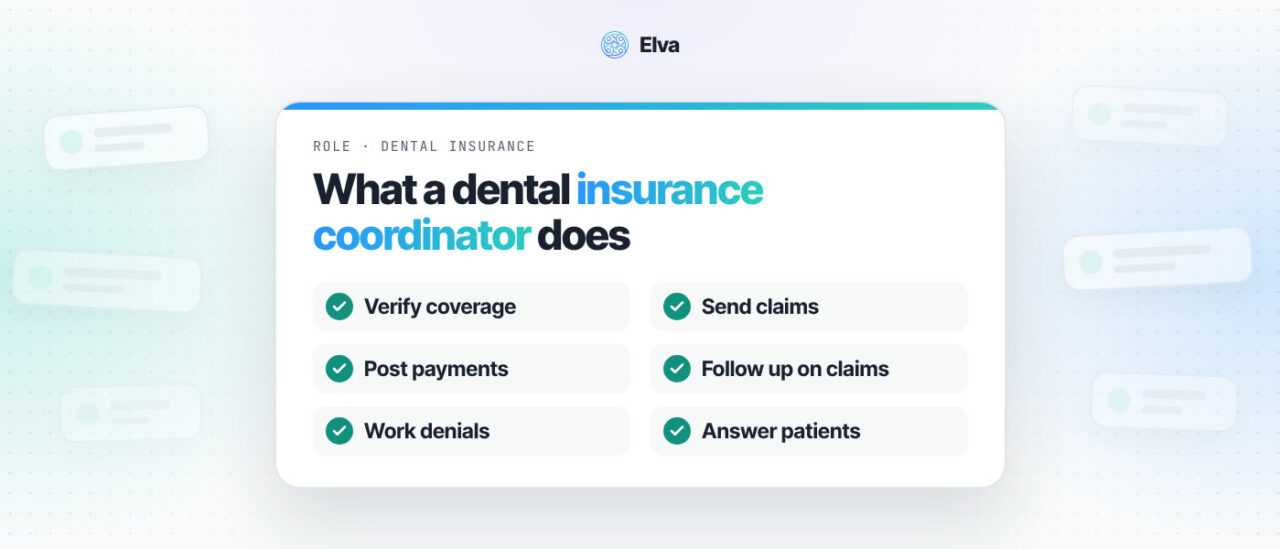
Quick answer: A dental insurance coordinator is the person in a dental office who handles insurance from start to finish: verifying coverage before the visit, sending claims, posting insurance payments, following up on unpaid claims and working denials. In many offices the same person is also called the dental biller, and in a small practice the office manager often does the job.
The role decides how much of the practice’s production turns into money in the bank. It is also one of the hardest front-office roles to fill and to cover when the person is away.
What a dental insurance coordinator does
Before the visit
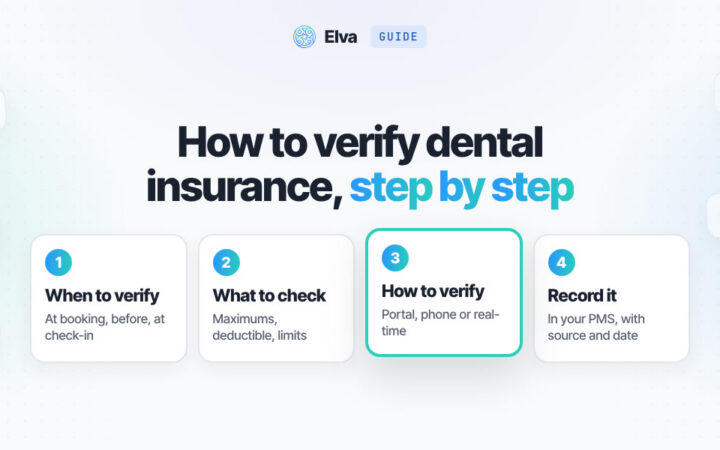
- Verifies that each patient’s plan is active, and reads the benefits: the maximum and what is left, the deductible, coverage percentages, frequency limits and waiting periods.
- Sorts out which plan pays first when a patient has two.
- Sends a pre-authorization where the plan requires one.
- Tells the front desk what the patient is likely to owe.
After the visit
- Sends the claim with the x-rays, charting and narrative the payer asks for.
- Posts each insurance payment against the right procedures, with the write-off and the patient’s share.
- Follows up on claims that have not been paid.
- Works denials: corrects and resends, appeals, or bills the patient.
- Answers patients’ questions about what their plan paid and why.
For the full sequence, see our guide to dental revenue cycle management.
Dental insurance coordinator duties, as a checklist
| When | Duty |
|---|---|
| Daily | Verify coverage for the next days’ schedule |
| Daily | Send the day’s claims with attachments |
| Daily | Post insurance payments as they arrive |
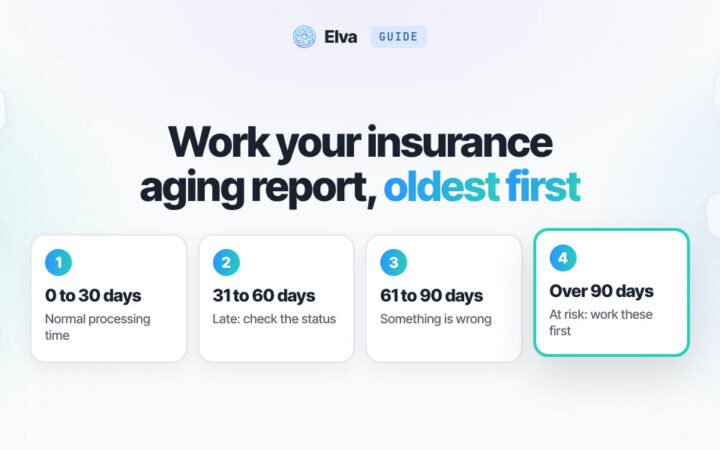
| Weekly | Work the insurance aging report |
| Weekly | Follow up on pre-authorizations |
| As they arrive | Work denials and requests for more information |
| Ongoing | Keep each payer’s fee schedule and rules up to date |
Skills the role needs
- Reading a benefits breakdown. Knowing what a frequency limit, a downgrade or a missing-tooth clause means for a given treatment.
- CDT codes and claim forms. Enough to check that the claim matches what was done.
- Your practice system. Where insurance plans, claims and payments live in it.
- Payer portals and phone calls. Each payer has its own portal, its own sign-in and its own rules.
- Plain explanations. Patients ask why the plan paid what it paid.
- Persistence. Unpaid claims do not chase themselves.
What an in-house coordinator gives a practice
A comparison published by the American Association of Dental Office Management (AADOM) lists four advantages of keeping an insurance coordinator in the office: control over claims, communication with the team and with patients, cost in a smaller practice, and knowledge of the patients and their treatment, which lets errors be caught before a claim is sent.1
The same article notes the weak point: billing is hard to learn, and harder still to teach during staff turnover.1 We wrote about that risk in when your dental biller leaves.
Where the time goes
Much of the coordinator’s day is spent on steps that are still done by hand. The 2024 CAQH Index measured what those steps cost dental providers:2
| Task | By hand | Electronic |
|---|---|---|
| Claim status inquiry | $12.01 | $3.71 |
| Remittance advice | $3.70 | $1.73 |
| Claim submission | $3.64 | $2.71 |
The same report found that only 28% of dental claim status inquiries were fully electronic, and that 39% of dental remittance advice arrived as an ERA.2 The rest is portals, phone calls and paper.
What software can take off the coordinator
The parts of the job that repeat are the parts software now does: checking coverage before each visit, posting payments, checking on unpaid claims, and preparing the next step for a denial. The parts that need a person stay with the coordinator: explaining a plan to a patient, deciding whether to appeal, and anything that needs the dentist.
That is the split Elva works to. It checks each insured patient’s coverage at booking and again the day before the visit, posts insurance payments in your practice system, follows up on claims that have gone quiet, and works out the next step for each denied or short-paid claim. Your team confirms the work until you decide Elva can act on its own, and anything it cannot settle comes to your coordinator with every try shown. See Elva’s dental RCM software.
FAQ
What does a dental insurance coordinator do?
They handle the practice’s insurance work: verifying coverage before visits, sending claims, posting insurance payments, following up on unpaid claims, working denials and answering patients’ questions about their benefits.
Is a dental insurance coordinator the same as a dental biller?
Often, yes. Many offices use the two titles for the same job. Where they are separate, the coordinator usually handles verification and patient questions, and the biller handles claims, posting and follow-up.
What skills does a dental insurance coordinator need?
They need to read a benefits breakdown, know CDT codes and claim forms well enough to check a claim, work in the practice system and payer portals, explain coverage to patients in plain words, and keep following up until a claim is paid.
How many insurance coordinators does a dental practice need?
It depends on how many insured visits you see and how much of the work is done by hand. Count the hours your team spends each week on verification, claims, posting and follow-up before deciding.
Should a practice hire an insurance coordinator or outsource billing?
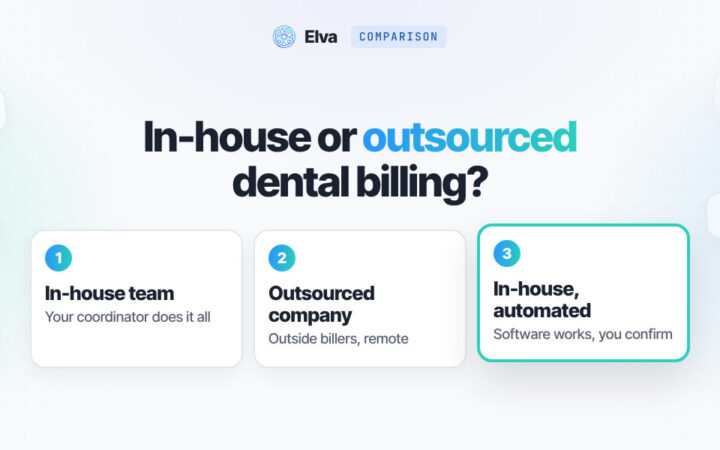
It depends on whether you can hire and keep a trained person and cover them when they are away. Our comparison of in-house vs outsourced dental billing sets out both, and a third option.
Can software replace a dental insurance coordinator?
No. Software can do the repetitive steps, such as checking coverage, posting payments and following up on claims. A person still explains plans to patients, decides on appeals and handles what the software cannot settle.
Related: how to work a dental insurance aging report · how to reduce dental claim denials · best dental insurance verification software
1 Tracy Gryger, MAADOM, “In-House Insurance Coordinator vs. Third Party Billing: What is Best for Your Practice?”, American Association of Dental Office Management, 28 June 2024. dentalmanagers.com
2 CAQH, 2024 CAQH Index (2023 data), dental section. caqh.org