On this page
Quick answer: A dental no-show policy tells patients how much notice you need to change an appointment, what happens when they miss one, and when you stop booking them ahead. Patients should see it at booking, sign it on the intake form and get a short reminder before each visit. Whether you charge a fee depends on your payer mix: Medicaid patients can’t be charged for missed appointments.
No-shows are a schedule problem first and a policy problem second. In an April 2023 ADA Health Policy Institute poll, 81.3% of dentists named no-shows and cancellations with less than 24 hours’ notice as a barrier to a full schedule (Becker’s Dental Review, May 2023). A written policy won’t fix that alone. It gives your front desk one rule to apply the same way every time, and it gives patients a fair warning before anything happens.
This is general information, not legal advice. Check your state dental board rules and your payer contracts before you adopt a fee.
What a dental no-show policy should include
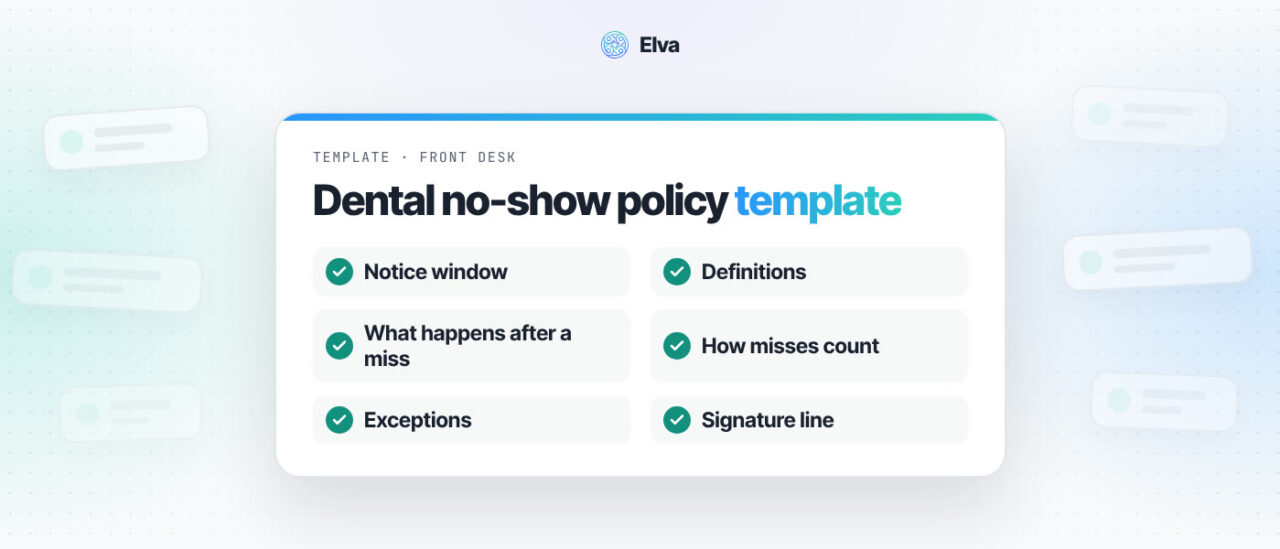
A dental no-show policy needs six parts. Keep it to one page so patients actually read it.
- Notice window. How far ahead a patient must cancel or move a visit, for example 24 or 48 hours. Pick a window your team can refill.
- Definitions. What counts as a no-show, a no call no show and a late cancellation. A no call no show is a patient who misses the visit without contacting the office at all.
- What happens after a miss. A rebooking step, a fee, a deposit for the next visit, or limits on booking ahead.
- How you count. Misses counted over a rolling 12 months, so one bad week years ago doesn’t follow a patient forever.
- Exceptions. Emergencies, illness, weather and anything else your doctor wants to excuse.
- How patients reach you. Phone, text reply and office hours, so “I couldn’t get through” isn’t a reason.
Copy-ready dental no-show policy template
Paste this into your forms or website and replace the bracketed parts. It is written for patients, so it stays short and plain.
[Practice name] Appointment Policy
We save time in our schedule just for you. When an appointment is missed, another patient waits longer for care.
Changing your appointment. Please call or text us at [phone] at least [24/48] hours before your visit if you need to cancel or reschedule. You can also reply to any reminder text.
Missed appointments. A missed appointment is a visit you don’t attend without [24/48] hours’ notice, including late cancellations and no call no shows.
- After a first missed appointment, we will contact you to rebook.
- After a second missed appointment in 12 months, [we may ask for a deposit of $[amount] to book your next visit / a fee of $[amount] may apply / we may offer you same-day or short-notice openings instead of booking ahead].
- After a third missed appointment in 12 months, the doctor will review whether we can keep scheduling future visits.
Exceptions. We understand emergencies happen. Please call us as soon as you can and we will work with you.
Insurance. Missed appointment fees are not billed to insurance. [Practice name] does not charge missed appointment fees where a patient’s plan or state program does not allow it.
I have read and understand this policy.
Patient or guardian signature: ________ Date: ________
The insurance line matters. Insurance doesn’t pay for a visit that never happened, and some programs bar the fee completely, as the next section explains.
Should you charge a no-show fee? Options and trade-offs
There is no single right answer on fees. The table compares four common setups.
| Option | How it works | Upside | Trade-off |
|---|---|---|---|
| No fee, rebooking rules | Misses lead to a call, then short-notice openings only | No billing disputes; works for every payer | Relies on the front desk following through |
| Fee after a grace miss | First miss is a warning; the second carries a fee | Fair to patients with one bad day | Fee must be tracked and collected; some payers bar it |
| Deposit for the next visit | Patient pays ahead for the next long visit after repeat misses | Protects long procedures | Needs a payment step at booking |
| Fee on every miss | Fee charged each time, no warning | Simple to explain | Most likely to upset patients and trigger complaints |
Before you choose, check who is in your chair.
- Medicaid. Federal guidance from 1995 says providers may not bill Medicaid recipients for missed appointments, because “a missed appointment is not a distinct reimbursable service” (CMS guidance via HHS). Colorado’s Medicaid agency says practices also can’t ask members to sign forms accepting liability for missed visits (Colorado HCPF). In California, the CDA states that providers cannot bill Medi-Cal patients for missed appointments (CDA, Aug 2025).
- Medicare. For practices that bill Medicare, CMS allows a missed-appointment fee only when the same policy and amount apply to every patient (CMS MLN Matters MM5613).
- Commercial plans and PPOs. Your participating-provider agreement may limit what you can charge plan members. Read the contract or ask the plan’s provider relations team.
- State rules. States differ. Your state dental association or board is the place to confirm.
If a large share of your patients are on Medicaid, a rebooking-based policy is usually the only version you can apply to everyone the same way.
How to communicate your no-show policy
A policy works when patients hear it three times before they can break it: at booking, on the forms and in the reminder.
At booking
Say it once, in one sentence: “We ask for [24] hours’ notice to change a visit, and our policy is in your forms.” Note in the patient’s record that it was mentioned.
On the intake form
Put the full policy and a signature line in your new-patient packet, and ask returning patients to sign it again once a year. With dental digital intake forms, the signed copy syncs to the patient’s record instead of a paper file.
In reminder texts
Reminders should point to the policy without lecturing. Keep them short, and keep treatment details and prices out of them. Here are three lines you can adapt:
- Confirmation (3 days before): “Hi [first name], this is [practice]. You’re booked for [day] at [time]. Reply C to confirm or call [phone] to change it. Changes need [24] hours’ notice.”
- Day before, not yet confirmed: “Hi [first name], we still have you for tomorrow at [time]. Please reply C to confirm, or call [phone] today if you can’t make it.”
- After a missed visit: “Hi [first name], we missed you today at [time]. Call [phone] or reply here and we’ll find you a new time.”
For more wording and send times, see our dental appointment reminder templates.
When to dismiss a patient and when to re-engage
Most missed appointments call for re-engagement, not dismissal. Use a simple ladder and write down each step.
- First miss: rebooking text the same day, then a call if there’s no reply.
- Second miss in 12 months: a call from the office manager, a note in the chart, and the next step from your policy (deposit, fee where allowed, or short-notice openings).
- Third miss in 12 months: the doctor reviews the pattern, the patient’s treatment status and any barriers such as transport or work hours.
- Dismissal, if chosen: a formal written notice, sent by first-class and certified mail with a return receipt, as the CDA recommends (CDA, Jun 2022).
Be careful mid-treatment. The ADA Code of Ethics says a dentist who has started a course of treatment should not stop “without giving the patient adequate notice” and the chance to find another dentist (ADA Code of Ethics, 2.F). The CDA’s risk team also advises that automatic dismissal is not recommended. For Medi-Cal patients, the CDA asks practices to make every attempt to reschedule before dismissing.
Re-engage when the misses have a fixable cause: a schedule clash, a cost worry, a phone number that changed. Dismiss only after repeated misses with no response, and never as the first reaction.
Where software takes the work off the front desk
A policy is only as consistent as the follow-through. That is where most offices slip, because confirmation calls and rebooking texts get squeezed between check-ins.
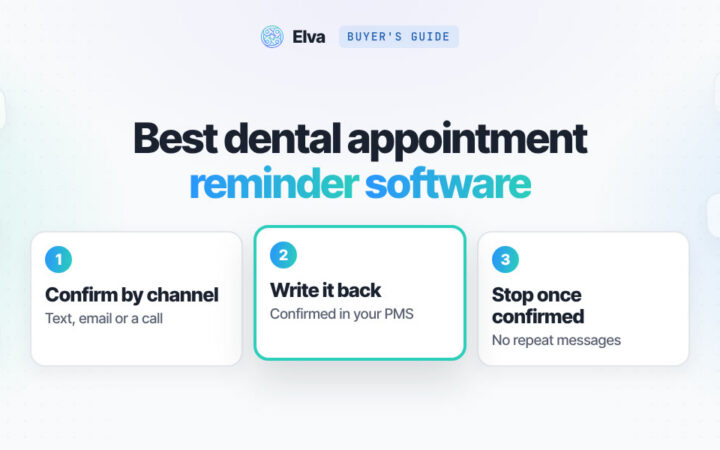
With dental appointment reminder software like Elva, each visit is confirmed by text, email or call at the times you set. Calls go only to patients who haven’t confirmed, confirmed status shows on the calendar, and a missed appointment triggers a rebook text. Elva works with major PMSs, including Dentrix, Dentrix Ascend, Open Dental, Eaglesoft, Curve Dental, Denticon and CareStack. Don’t see your PMS? Contact us.
Elva is HIPAA compliant and signs a BAA with every practice. Reminder texts and emails don’t carry treatment details or prices.
For the patterns that come before a miss, read our guide on how to reduce dental no-shows.
Book a demo to see how Elva confirms visits and follows up on misses in your PMS.
Frequently asked questions
What should a dental no-show policy include?
A notice window, clear definitions of a no-show and a late cancellation, what happens after each miss, how misses are counted, exceptions for emergencies, and how patients can reach you. Have patients sign it on the intake form.
Can a dental office charge for a missed appointment?
Often yes, if the fee is in a policy the patient agreed to and your payer contracts and state rules allow it. Insurance doesn’t pay the fee, and Medicaid patients can’t be charged. This is general information, not legal advice.
Can I charge Medicaid patients a no-show fee?
No. CMS guidance says providers may not bill Medicaid recipients for missed appointments, and state programs such as Colorado’s and California’s Medi-Cal say the same. Use rebooking steps for these patients instead.
How many no-shows before you dismiss a dental patient?
There’s no set number, so write your own into the policy. The template above has the doctor review after three misses in 12 months. Dismissal should come with written notice, and the ADA Code of Ethics asks for adequate notice before stopping a course of treatment.