On this page
A dental insurance breakdown is the full record of what a patient’s plan will pay for the care you plan to do. An eligibility check only tells you the plan is active on the date of service. “Active” says nothing about a downgrade on a molar crown, a cleaning used up at another office, or a waiting period on major work. Those gaps turn into short payments and surprise bills weeks later. This guide lists every field a full breakdown should capture, what goes wrong when one is missing, and where each answer comes from.
Key Takeaways
- “Active” is the start, not the answer. An eligibility check confirms the plan exists. A breakdown tells you what the plan pays for this patient and this treatment.
- Most surprises come from rules, not percentages. Downgrades, frequency limits, waiting periods and missing-tooth clauses change the payment even when the coverage percentage looks right.
- Each field has a source. Some answers come back in an electronic check. Others need the payer portal, a call, or your own paid claims for that payer.
- Write down what you don’t know. A breakdown that marks gaps is safer than one that fills them with assumptions.
Eligibility check vs full dental benefits breakdown
An eligibility check answers “is this plan active today?” A full benefits breakdown answers “what will this plan pay, and what will the patient owe, for this treatment?”
| Eligibility check | Full benefits breakdown | |
|---|---|---|
| Question it answers | Is the coverage active on the date of service? | What does the plan pay for these procedures, and what is left for the patient? |
| What it returns | Status, effective dates, plan name and type, member and group ID | Everything in the check, plus maximums, deductibles, coverage by service class, limits by code and plan rules |
| When it is enough | A routine visit for a patient whose plan you checked recently | New patients, new plans, major treatment, and the first visits of a new plan year |
| What it misses | History, frequencies, downgrades, waiting periods, exclusions | Only what the payer doesn’t disclose, which a good breakdown labels as unknown |
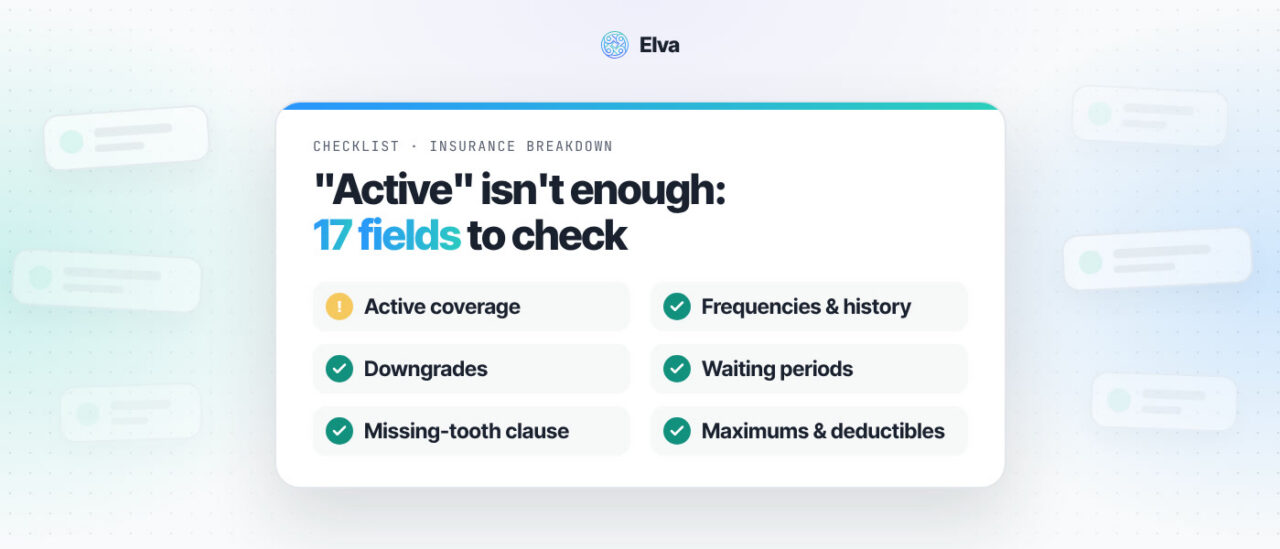
What a full dental insurance breakdown includes
- Patient and plan identity. Subscriber name and date of birth, the patient’s relationship to the subscriber, member ID, group number, payer, plan name and plan type (PPO, DHMO, indemnity).
- Coverage dates. Effective date, termination date if any, and when the plan year resets (calendar year or another date).
- Network status. Whether your office is in network for this plan, and which fee schedule applies.
- Annual maximum. The total maximum, how much is used, and how much is left.
- Deductible. The amount, how much is met, and which service classes it applies to (often not preventive).
- Coverage by service class. The percentage paid for preventive, basic and major care, plus any separate rules for orthodontics, implants or perio.
- Frequency limits and service history. How often the plan pays for exams, cleanings, X-rays, fluoride and perio maintenance, and when each was last paid. Ask for history, not only the limit.
- Age limits. For example, age cut-offs on fluoride, sealants or orthodontics.
- Waiting periods. Any time the patient must wait before basic or major services are covered.
- Replacement intervals. How long before the plan pays to replace a crown, bridge or denture.
- Downgrades and alternate benefits. Whether the plan pays a lower-cost alternative, such as a metal rate for a posterior crown or an amalgam rate for a composite filling.
- Missing-tooth clause. Whether the plan excludes replacing a tooth lost before coverage began.
- Exclusions and bundling rules. Procedures the plan never pays, and procedures it folds into another (for example, a build-up paid as part of the crown).
- Coordination of benefits. Secondary or dual coverage, which plan is primary, and the coordination method.
- Pre-authorization or predetermination needs. Which planned procedures need one before treatment.
- What is not known. Any field the payer did not confirm, written as unknown rather than assumed.
- Proof. Who checked, when, which source gave each answer, and a reference number or call reference.
Copy this list into your breakdown form, or use it to check the form you already have. A blank line for each field makes gaps visible at a glance.
Which missing field causes which problem
Most billing surprises trace back to one field nobody captured. This map shows the usual result when a field is skipped. It describes what tends to happen, not how any one payer will process a claim.
| Field skipped | What usually happens later |
|---|---|
| Service history | A cleaning or X-ray is refused as over the frequency limit because it was already paid at another office |
| Downgrade or alternate benefit | The claim pays at the lower-cost rate and the patient gets a balance nobody quoted |
| Waiting period | Basic or major work is refused because the patient joined the plan too recently |
| Missing-tooth clause | A bridge or implant is refused for a tooth lost before coverage began |
| Maximum used so far | The estimate assumes money the plan already spent this year |
| Deductible met | The patient’s share is quoted too low or too high |
| Coordination of benefits | The claim goes to the wrong payer first and payment stalls |
| Replacement interval | A crown or denture replacement is refused as too soon |
| Bundling rules | A procedure billed on its own pays nothing because the plan folds it into another |
Where each answer in a breakdown comes from
No single source answers every field. Practices check coverage in three main ways, according to the ADA: fully electronic checks, payer portals, and manual requests by phone, fax, email or mail. The same ADA News report notes that portal checks can take more time and cost more.
The work adds up. Dental spending on eligibility and benefit verification rose 15% to $2.1 billion, per the 2024 CAQH Index (2023 data), reported by ADA News in March 2025.
- Electronic eligibility check. Fast and good for status, dates, plan type and often maximums and deductibles. Detail on history and plan rules varies by payer.
- Payer portal. Often shows service history, frequencies and plan notes the electronic response leaves out.
- Phone call to the payer. Fills the remaining gaps. Write down the call reference and the representative’s answer.
- Your own paid claims. How a payer actually paid the same procedure for your office before is strong evidence for rules like bundling and downgrades.
- The payer’s provider manual. States the written policy behind a rule, which helps when you appeal.
When to run a full breakdown
Run a full breakdown when the plan, the patient or the treatment is new. A quick eligibility check is enough between those moments for most routine visits.
- At booking for a new patient, so the first estimate is right.
- Before major treatment, so the quote reflects downgrades, waiting periods and replacement rules.
- In January and at any plan-year reset, when maximums, deductibles and sometimes the plan itself change.
- When a patient tells you their employer or plan changed.
- Before the visit, as a final check that nothing changed since booking.
Year-end is the other side of the same data. Patients with money left on their maximum are the ones an unused dental benefits reminder should reach before the reset.
Mark the gaps instead of guessing them
A breakdown is only as good as its weakest field, so state what you don’t know. Payers don’t always disclose history for a patient who is new to your office. Some list frequencies only as a general standard. Secondary coverage may not appear at all.
Write “unknown” in those fields and tell the patient the estimate depends on them. A guessed field looks like a confirmed one on the form. Then nobody re-checks it, and the claim pays differently from the quote.
How Elva builds a full breakdown
Elva runs the verification inside your practice management system. It reads the patient and plan from the PMS and writes the results back, on all seven PMSs it connects to. It checks eligibility at booking and again before the visit.
The report covers the fields in the checklist above. That includes eligibility status, plan type and network, annual maximum, deductible and coverage percentages. It also includes CDT-level frequency limits and service history, waiting periods, age limits, downgrades and alternate benefits, missing-tooth clauses, coordination of benefits and the patient’s share.
- Sources, used only when needed. An electronic eligibility check through Stedi, your office’s own paid claims, the payer’s provider manual, the payer portal, and a call to the payer by Elva. The report shows which source gave which answer.
- Gaps stated, not filled. A “What is not known” section lists anything the payer did not confirm.
- A stored snapshot. Each result is saved, so if a claim is later denied, the appeal can cite what the payer said.
- Live Check for walk-ins and callers. The same report for someone at the counter or on the phone, including people who are not patients yet. The screen notes it usually answers in 10 to 30 seconds.
- A Chrome extension. The ELVA Dental Insurance Eligibility Check extension opens the report beside your form, with the PMS still open behind it.
Eligibility is not a guarantee of payment. Final payment depends on plan terms and how the claim is processed. See how dental insurance eligibility verification software handles this before every visit, or compare options in our list of the best dental insurance verification software.
A clean breakdown also feeds the rest of the claim. It is the first step if you want to reduce dental claim denials, and it is the starting data for anyone working out how to automate dental insurance claims. For the full picture of how verification, claims and payments connect, see our guide to dental revenue cycle management.
Frequently Asked Questions
What should a full dental insurance breakdown include?
A full dental insurance breakdown includes the plan and subscriber details, coverage dates, network status, the annual maximum used and left, the deductible met, coverage by service class, frequency limits with service history, age limits, waiting periods, replacement intervals, downgrades, missing-tooth clauses, exclusions, coordination of benefits, and a note of anything the payer did not confirm.
What is the difference between an eligibility check and a dental insurance breakdown?
An eligibility check confirms the plan is active on the date of service. A dental insurance breakdown goes further and shows what the plan will pay for specific procedures, which rules reduce that payment, and what the patient will owe.
Is a dental insurance breakdown a guarantee of payment?
No. A breakdown records what the payer reported at the time of the check. Final payment depends on the plan terms and how the claim is processed, so keep the date, the source and a reference number for every answer.
How often should a dental office run a full breakdown?
Run a full breakdown for new patients, before major treatment, at the start of a new plan year and whenever a patient’s plan changes. Between those moments, a quick eligibility check before the visit is usually enough for routine care.
Can a dental insurance breakdown be automated?
Yes. Elva checks eligibility and the full benefits detail at booking and before the visit, writes the results into your practice management system, and lists anything the payer did not confirm instead of guessing it.
Sources
- ADA News, "Benefit verification drives increased administrative spending in dental offices," March 24, 2025, citing the 2024 CAQH Index (2023 data). Retrieved November 16, 2026.
- Elva: product documentation and the eligibility check report (demo account data), as of November 2026.