“AI-powered RCM automation” gets used to describe a lot of different things — a system that just moves data from one place to another, a system that applies a fixed rule, and a system that’s actually interpreting ambiguous information and making a judgment call. Those are three different capabilities with three different levels of risk if something goes wrong, and most vendor content treats them as interchangeable. This guide breaks down what’s actually automatable in dental RCM today, what still needs a person, and how to tell whether automation is doing what it claims.
Dental RCM automation uses software and AI to handle repetitive front- and back-office revenue cycle tasks — insurance verification, claims scrubbing, payment posting, and denial tracking — that would otherwise require a staff member to do them manually. Not every task under that umbrella carries the same complexity or the same risk, which is the distinction most explanations of RCM automation skip.
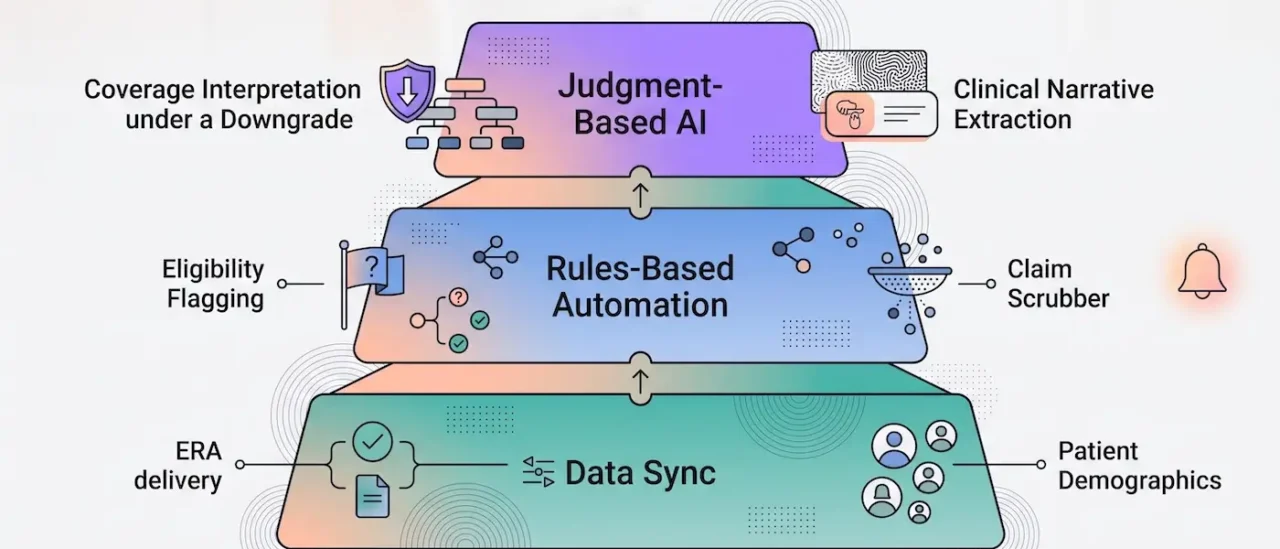
The Three Tiers of Dental RCM Automation
Not all automation is doing the same kind of work. Splitting it into tiers makes it possible to actually evaluate a claim like “we automate eligibility verification” instead of taking it at face value.
Data sync is the simplest tier: moving information from one system to another with no decision involved. An ERA landing in a practice’s inbox automatically instead of requiring a manual portal download is data sync — nothing is being interpreted, just delivered. Where a payer only sends paper remittances, OCR (optical character recognition) is what turns that scanned document into usable data before it can be posted.
Rules-based automation — often built on RPA (robotic process automation) — applies a fixed, deterministic rule: if a claim is missing a required attachment, flag it before submission. If a patient’s plan hasn’t been checked in the last 30 days, trigger a verification. This is auditable — the rule is either being followed correctly or it isn’t — but it only works as well as the rule was written, and it can’t handle a case the rule didn’t anticipate.
Judgment-based AI is doing something closer to interpretation: reading a payer’s published policy against a practice’s actual claim history to catch a coverage downgrade the policy document alone wouldn’t show, or using NLP (natural language processing) to interpret a denial reason code or payer narrative that doesn’t map cleanly to a standard category. This tier produces the most value when it works, and it’s also the tier where “how do you know it’s right” matters most.
Most of what’s marketed as “AI-powered RCM automation” is actually the first two tiers wearing an AI label. That’s not a knock on those tools — data sync and rules-based automation genuinely save time — but it’s worth knowing which tier a given claim is actually describing.
Traditional vs. AI-Powered Dental Revenue Cycle Management, by Stage
| RCM Stage | Traditional Approach | Automated Approach | Automation Tier & Risk Profile |
|---|---|---|---|
| Eligibility verification | Manual phone calls or payer portal checks | Automatic daily schedule scanning against payer data | Data sync → Rules-based — Low risk |
| Claims submission | Manual review for missing codes or attachments | Automated pre-submission claim scrubbing | Rules-based — Low-to-medium risk |
| Payment posting | Manual EOB data entry and matching | Automated ERA parsing and posting | Data sync → Rules-based — Low risk |
| Denial management | Reactive tracking, delayed follow-up | Denial categorization and root-cause flagging | Rules-based → Judgment-based — Medium-to-high risk |
| Coverage interpretation | Reading a policy document at face value | Cross-checking policy against actual claim history | Judgment-based — Highest risk, highest value |
Where Automation Fits in the Dental Revenue Cycle
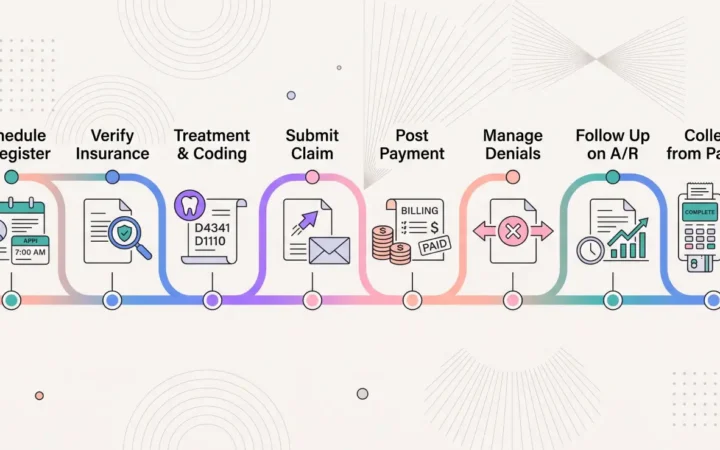
Mapped to the actual stages of the cycle (covered in full in what dental revenue cycle management is):
Insurance verification is where automation currently delivers the clearest win — automated eligibility verification checks active coverage, deductibles, and frequency limits before the patient is in the chair, replacing the morning-of phone call entirely.
Claims submission benefits from rules-based scrubbing that catches missing attachments and code mismatches before a claim goes out — see how dental claims submission software applies this before a claim leaves the practice.
Denial management sits at the boundary between rules-based and judgment-based: categorizing a denial by reason code is rules-based; understanding whether it’s worth appealing, and building the case for it, leans judgment-based. Dental denial management covers both.
Accounts receivable and payment posting combine data sync (ERA delivery), rules-based work (matching a payment to the right claim), and prioritization that benefits from judgment (which aging balance is actually worth chasing first). Automated dental claim follow up covers the full stack. For the posting step, see dental EOB posting and dental EOB processing, and for matching posted payments to bank deposits, dental insurance payment reconciliation. This is the same layered approach behind Elva’s broader dental RCM software suite.
What Can Go Wrong When Automation Runs Unchecked
The risk with judgment-based automation specifically isn’t that it fails loudly — it’s that it fails quietly, in ways that look correct on the surface. A payer’s published policy can say a procedure is covered, while the actual reimbursement pattern for that payer shows a consistent downgrade the policy document never mentions. A rule that was accurate last quarter can go stale the moment a payer renegotiates a contract or updates a fee schedule, and nothing flags it until a clean-looking claim comes back denied. A denial reason code can get auto-categorized into the wrong bucket, quietly lowering the odds it ever gets appealed.
None of these are failures of automation working too slowly — they’re the risk of automation running with confidence on outdated or incomplete information, and nobody noticing until the revenue is already lost. This is the piece most automation marketing skips, because it’s the least flattering part of the pitch. It’s also exactly the question worth asking before trusting a system with claim decisions: not just “does it automate this,” but “how would you know if it got it wrong.”
What to Look For in Dental RCM Automation
A buyer’s checklist shaped by the tiers above, not just feature names:
- Which tier is each claimed capability actually operating at? “Automates eligibility” could mean data sync alone, or genuine interpretation of coverage — worth asking directly.
- Is there a way to see why the automation made a specific call, not just what the output was?
- How does the system handle a payer policy change or a stale rule? Does anything flag drift, or does it run on the last version indefinitely?
- What’s the handoff to a human when something’s ambiguous? Full automation with no review path is a different risk profile than automation with a clear escalation point.
- Does it integrate with your existing practice management system, or does it require replacing what the practice already runs on?
- Does it connect through a native PMS API, or rely on screen-scraping a payer portal? API connections are generally more stable; screen-scraping tends to break when a payer changes their portal layout.
A Phased Approach to Adopting RCM Automation
Rolling out automation across an entire revenue cycle at once is rarely the right move — a staged approach surfaces problems while they’re still small.
Phase 1: Weeks 1–4 — Front-End Eligibility
Start with automated eligibility verification. It’s the lowest-risk tier (mostly data sync and rules-based), and it removes one of the most time-consuming manual tasks in the cycle immediately.
Phase 2: Weeks 5–8 — Mid-Cycle Claims Scrubbing
Add claim scrubbing to catch coding and attachment errors before submission — a rules-based layer that reduces first-pass rejections without introducing judgment-based risk yet.
Phase 3: Weeks 9–12 — Back-End Posting and Denial Intelligence
Bring in automated payment posting and denial categorization, and start evaluating judgment-based tools for the tasks — like coverage interpretation or appeal prioritization — where the payoff is highest but oversight matters most.
Automation Needs Oversight, Not Just Speed
Every tier of automation above genuinely saves time. But speed and accuracy aren’t the same thing, and the judgment-based tier in particular needs a way to check its work — not just trust it. That’s a different function from the automation itself: automation executes a task; oversight answers “why did it make that call, and what’s it based on.”
RCM Brain is Elva’s answer to that second part specifically — a plain-language way to ask why a claim was processed a certain way, sourced back to the actual payer policy, claim history, or ledger entry behind the answer, rather than taking an automated decision on faith.
Frequently Asked Questions
What is dental RCM automation? Software and AI that handle repetitive dental revenue cycle tasks — insurance verification, claims scrubbing, payment posting, and denial tracking — without requiring a staff member to do each one manually. It spans a range from simple data transfer to genuine interpretation of ambiguous claim or coverage information.
How is automation being used in dentistry? Most commonly for insurance eligibility checks before appointments, scrubbing claims for errors before submission, automatically posting payments from ERAs and EOBs, and flagging or categorizing denied claims for follow-up.
What tasks can actually be automated in dental RCM today? Data transfer (like ERA delivery) and rules-based checks (like flagging a missing attachment) are reliably automatable now. Judgment-based tasks — interpreting an ambiguous coverage situation, deciding whether a denial is worth appealing — are increasingly AI-assisted, but generally still benefit from a human review step.
Is dental RCM automation only useful for DSOs? No. Solo and small-group practices often see a proportionally larger benefit from automating front-end tasks like eligibility verification, since they typically have less administrative staff to absorb that manual workload in the first place.
What’s the difference between rules-based automation and AI in dental RCM? Rules-based automation applies a fixed, deterministic rule — the same input always produces the same output, and it’s straightforward to audit. AI-driven judgment involves interpreting information that doesn’t fit a simple rule, like reconciling a payer’s published policy against actual claim outcomes — more powerful, but it needs a way to verify its reasoning rather than being trusted outright.
The Bottom Line
Dental RCM automation isn’t one thing — it ranges from simple data sync to rules-based checks to genuine AI-driven judgment, and each tier carries a different level of risk if it’s wrong. The highest-value automation today combines the lower tiers, which are reliable and fast, with judgment-based tools that come with real visibility into how a decision was reached — not just a faster version of the old manual process.
For the fundamentals of the cycle automation is built on top of, see what dental revenue cycle management is.