
The letter goes out once
One mailing in November reaches patients who were already planning to book. Everyone else sets it aside, and nobody follows up. Elva keeps going by text, email and phone until the patient books or the sequence ends.
In the months before insurance benefits reset, Elva tells each patient how much they have left and books them before it's gone. It reaches patients by text, email and phone, answers their replies and puts the visit on your schedule, synced with your practice management system.
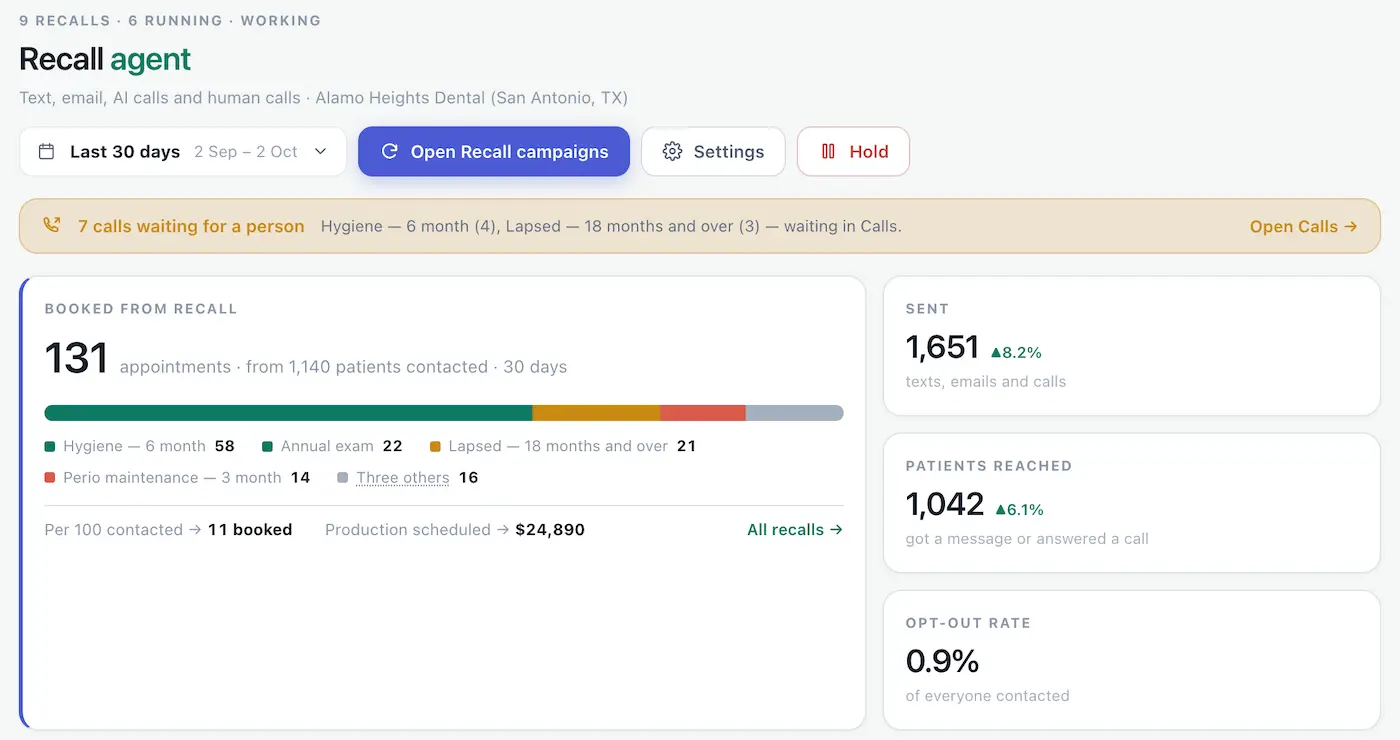
Elva works out which patients have benefits remaining and no appointment, and when their benefits reset, and leaves out anyone who opted out or can't be contacted.
Each message names how much the patient has left and when it expires, written for that patient from your brief and checked against their chart before it sends.
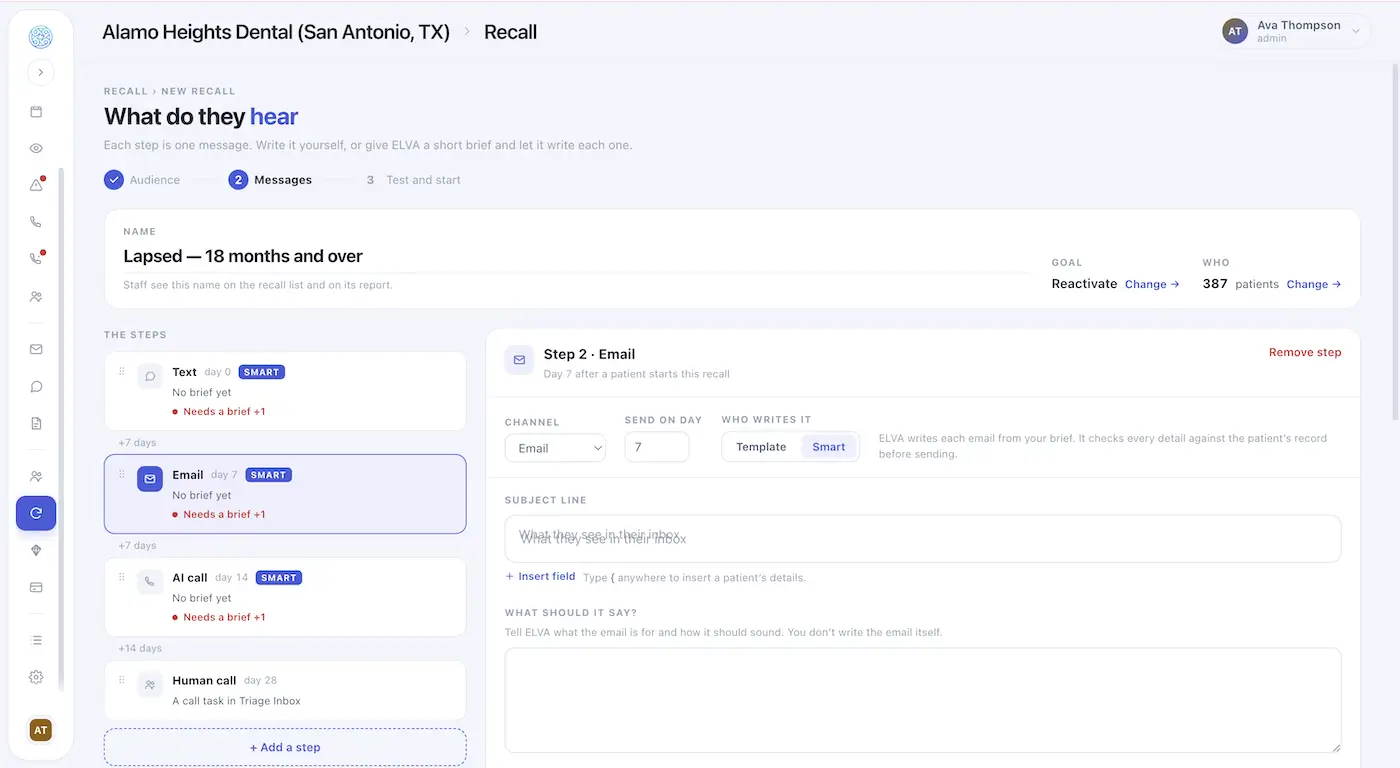
A text, then an email, then a phone call, on the days you choose, each going only to patients who haven't booked. Patients reply in their own words, and Elva answers and books the visit.
Patients still unbooked reach your Calls page with who to call, why, and what they were already sent. One tap records the outcome, and Elva carries on from there.
Nothing is sent until you press Start. You can change the days at any time, and pause any recall or hold all of them at once.
Remaining benefits — how much of the annual maximum each patient has left, so the message names a real number
Benefit deadline — reminders run in the months before benefits reset, while there is still time to book
Existing appointments — patients who already have a visit booked are left out, and anyone who books stops receiving messages, however they book
Contact details — patients with no mobile number or email are left out and counted, so you can see who the recall can't reach
Opt-outs — patients who opted out are never contacted, and replying STOP ends texts at once
What they're due for — the cleaning, the exam or both, so the message gives a real reason to come in before the deadline
Patient language — you write in English, and each patient reads and hears their own language
Contact limit — a cap on how often any patient hears from the practice, shared across everything Elva sends
Quiet hours — texts and calls go out only inside the hours you set
Combined messages — a patient who is due for a cleaning and has benefits left can get one message that covers both, not two
Chart facts — every name, date and number in a message is checked against the patient's chart before it sends
Replies — "Do you have anything before the end of the year?" gets real times with the right provider, at any hour, and the visit is booked in the conversation
Results — sent, reached, booked and attended, plus who the recall isn't reaching and why
That list is the end-of-year letter project most practices run once a year, by hand. Elva runs it for every patient, on the days you choose.
In a 20-minute demo we show how a recall is built from a sentence, how each message is written for the patient who gets it, and what your team sees on the call list.
An unused dental benefits reminder is a message sent before a patient's insurance benefits reset, telling them how much of their annual maximum is left and helping them book before it expires. Elva sends it automatically to every patient with benefits remaining, by text, email and phone.
By hand, it's the end-of-year letter: pull a list, write one letter, send it in November and hope. Every patient gets the same wording, whether they have $1,400 left or $40, and nothing follows up with the patients who don't respond.
Most dental plans run on a calendar year and reset on January 1, so unused maximums typically expire on December 31. Not every plan works that way. Some run on a fiscal or enrollment-date year, and NADP reports that 42% of PPO enrollees are in plans that roll part of an unused maximum into the next year. A generic "use it or lose it" warning is wrong for some of your patients.
Elva tells each patient how much they have left, so the message is a number and not a warning. It starts in the months before benefits reset, and it keeps following up until the patient books. Patients with diagnosed treatment they never booked have their own follow-up, and patients due for a cleaning are covered by hygiene recall.
One mailing in November reaches patients who were already planning to book. Everyone else sets it aside, and nobody follows up. Elva keeps going by text, email and phone until the patient books or the sequence ends.
"You may have benefits remaining" gives a patient with $1,400 left and a patient with $40 left the same nudge. A number is harder to ignore. Elva writes each message with what that patient actually has left.
Patients who act on the last reminder in mid-December find the schedule booked solid, and the benefit is gone. Starting in the fall gives them time to book. Elva covers the follow-up your front desk can't fit in while the schedule is at its busiest.
Some plans reset on a different date, and some roll part of the unused maximum into next year. A "use it or lose it" letter is the wrong message for those patients. A message built around each patient's own number doesn't make that mistake.
Patients with diagnosed treatment they never booked have their own page, unscheduled treatment follow-up. Elva Recall covers every other kind of recall too, from hygiene recall to patient reactivation.
Elva runs alongside your practice management system rather than replacing it, with real-time sync across Dentrix, Dentrix Ascend, Open Dental, Eaglesoft, Curve Dental, Denticon, and CareStack.
It reads your schedule and writes each booking back, so a patient who books drops off the list and stops receiving messages, however they booked.
 Authorized API Partner
 Official API Vendor Partner
Rules you can review. Who is included, how many touches and on which days, and what every message must say are all yours to set. Reports count sent, reached, booked and attended.
Human review where you want it. Read each step as three real patients would get it before anything is sent. Your team takes the personal calls, and on AI calls, whether Elva announces itself as automated is set per practice.
Limits that protect patients. A shared contact cap, quiet hours, one message instead of three, and instant opt-out. A patient can stop recall messages and keep their appointment reminders.
Handled to HIPAA standards. Patient data moves under a signed business associate agreement, encrypted at rest and in transit, and messages carry only what's needed to book a visit.
Few patients use their whole maximum. In 2024, only 2.9% of group dental PPO enrollees reached their annual benefit maximum, up from 1.7% the year before and the highest share in six years. For most patients, there is benefit left to book.
Source: National Association of Dental Plans (NADP), 2025 Dental Benefits Report: Plan Design (2024 data), as reported in "New Data Sheds Light on Dental Benefits and the Cost of Serving Enrollees," 25 November 2025. Retrieved 5 October 2026.
"Use it or lose it" is not true of every plan. 42% of PPO enrollees are in plans with an annual maximum rollover, where part of the unused amount carries into the next year.
Source: National Association of Dental Plans (NADP), 2025 Dental Benefits Report: Plan Design (2024 data), as reported in "New Data Sheds Light on Dental Benefits and the Cost of Serving Enrollees," 25 November 2025. Retrieved 5 October 2026.
Coverage and visits go together. In 2019, 75.0% of insured US adults aged 18–64 had a dental visit in the past 12 months, against 47.8% of adults without dental insurance.
Source: CDC, "QuickStats: Percentage of Adults Aged 18–64 Years Who Had a Dental Visit in the Past 12 Months, by Dental Insurance and Year," MMWR, National Health Interview Survey 2019–2020, 22 April 2022. Retrieved 5 October 2026.
An unused dental benefits reminder is a message sent before a patient's insurance benefits reset, telling them how much of their annual maximum is left and helping them book before it expires. Elva sends it automatically by text, email and phone to patients with benefits remaining, and books the visit when they reply.
An end-of-year benefits letter, also called a use-it-or-lose-it letter, is a one-time notice a practice sends in the fall to remind patients that their benefits are about to expire. Elva does the same job continuously: each patient hears how much they have left, by text, email and phone, and the follow-up continues until they book.
Yes, annual maximums reset once per benefit year. For most plans that is the calendar year, so benefits reset on January 1 and unused amounts expire on December 31. Some plans run on a fiscal or enrollment-date year, so the reset date differs from patient to patient.
Often not, but not never. NADP's 2025 report found that 42% of PPO enrollees are in plans with an annual maximum rollover, where part of the unused amount carries forward. Whether a patient's benefits roll over depends on their own plan, which is why a generic warning to every patient can be wrong.
Early enough that patients can still book. Most practices start in the fall and keep reminding through December, and Elva begins in the months before each patient's benefits reset. You set the days, and nothing is sent until you press Start.
Patients who have benefits remaining and no appointment. It leaves out patients who opted out, have no mobile number or email, or already have a visit booked, and a shared contact limit stops anyone hearing from you too often. Before you press Start you see how many patients match and the first 20, with the reason each is on the list.
No. Elva reaches patients by text, email and phone, which are the channels patients answer fastest, and a patient can book in the same conversation. Patients who don't respond reach your team's call list.
It names how much the patient has left and when it expires, and offers a way to book. Give Elva a short brief on what the message is for and how it should sound, and it writes each patient their own, in their own language. You can also write your own, and you read each step before anything is sent.
Elva syncs in real time with Dentrix, Dentrix Ascend, Open Dental, Eaglesoft, Curve Dental, Denticon, and CareStack. It reads your schedule and writes bookings back, so a patient who books leaves the list immediately.
Replies are answered in the patient's own language at any hour, and Elva offers times and books the visit in the conversation. Patients who never respond reach your Calls page with who to call and why. Phone calls are made by the Elva AI Receptionist; without it, reminders run on text and email and your team makes the calls.
Elva is built for dental practices and is HIPAA compliant. We sign a business associate agreement with every practice, data is encrypted at rest and in transit, and messages carry only what's needed to book a visit. Patients can stop texts instantly by replying STOP, and can stop recall messages while keeping their appointment reminders.
Unused benefits reminders are part of Elva Recall, which is included in ELVA Core. Elva is a paid platform; tell us your practice size and setup and you'll have a quote within 24 hours.
See how Elva tells each patient what they have left, and read the messages your patients would get.