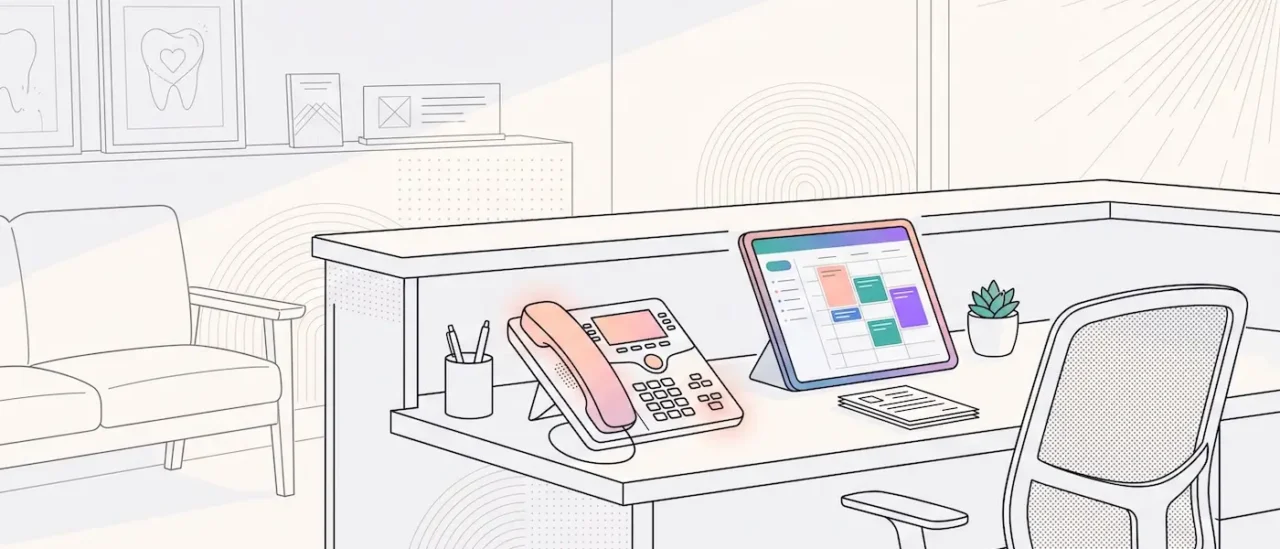
Search for a dental virtual receptionist and you’ll find three very different things sold under the same name: a remote human who answers your phones from somewhere else, an answering service that takes messages, and an AI receptionist that answers and books on its own. They solve the same problem, calls your front desk can’t get to, in completely different ways.
This guide puts the three side by side: who actually answers, whether the appointment lands in your schedule, what each costs, where a human still does better, and how to pick the right mix for your practice.
Quick answer: A remote human virtual receptionist is the right fit when you need a warm human voice on a modest number of calls and can live with per-minute or per-call pricing. An AI receptionist is the better fit when you need every call answered at once, around the clock, with bookings written straight into your practice management system. Many practices use AI for the volume and keep their own team for the calls that need a person.
What Is a Dental Virtual Receptionist?
Traditionally, a dental virtual receptionist is a trained person working remotely who answers your practice’s phone line as if they were sitting at your front desk. They greet callers in your practice’s name, answer common questions, take messages, and, depending on the service and your systems, schedule appointments.
The term has since stretched. Answering services now call themselves virtual receptionists, and so do AI receptionist vendors. So before comparing providers, it helps to know which of three models you’re actually looking at.
Three Ways to Cover Your Phones Without Hiring
1. Remote human receptionist
A live person, employed by the service, answers your calls from a script and a knowledge sheet you provide. The best services train staff on dental terminology and can book appointments if they’re given access to your scheduling system. Coverage hours, languages and whether they can book vary by provider and plan.
2. Answering service
Also staffed by people, but built for message-taking rather than front-desk work. An answering service typically captures the caller’s details and reason for calling, then passes a message to your team or an on-call dentist. The patient usually ends the call without a booked appointment. We compare this model in more depth in our guide to dental answering service options for after-hours calls.
3. AI receptionist
Software answers the call in natural speech, understands what the caller needs, and acts on it: checking real availability, booking or rescheduling, answering questions from your practice’s own information, and handing off to a person when it should. A dental AI receptionist built for dentistry writes appointments directly into your practice management system during the call, and it answers every incoming call at the same time rather than one after another.
Virtual Receptionist vs Answering Service vs AI Receptionist
| Remote human receptionist | Answering service | AI receptionist | |
|---|---|---|---|
| Who answers | A remote person | A remote person | Software, with handoff to your team |
| Books appointments | Sometimes, if given scheduling access | Rarely; takes a message | Yes, directly into the PMS when integrated |
| Calls at the same time | One per agent; busy periods can mean holds | One per agent | Every incoming call at once |
| Hours | Depends on the plan | Often 24/7 | 24/7 |
| Insurance questions | Basic, from a script | Message only | Answers from your practice’s own information; deeper checks depend on the platform |
| Emergencies | Follows your script, escalates by phone or message | Takes a message, pages on-call | Follows your escalation rules and hands off to a person |
| Consistency | Varies by agent and shift | Varies by agent | Same rules on every call |
| Typical pricing | Monthly plan with included minutes or calls, plus overage | Monthly plan, often per call or per minute | Monthly subscription; models vary by vendor |
What Does a Dental Virtual Receptionist Cost?
Human virtual receptionist services usually price by the minute or by the call, with a monthly bundle and an overage rate when you go over. Two widely used providers publish their rates (retrieved October 14, 2026):
- Ruby’s virtual receptionist plans run from $250 a month for 50 minutes to $1,725 a month for 500 minutes, with scheduling available as an optional feature.
- Smith.ai’s human-staffed receptionist plans run from $300 a month for 30 calls to $2,100 a month for 300 calls, with overage of $8.50 to $11.50 per additional call.
Those general-business plans aren’t built for dentistry, and dental-specific services set their own prices, but they show how the model works: your bill rises with your call volume. A busy practice that sends its overflow, lunch hour and after-hours calls to a human service pays for every one of those minutes.
AI receptionists are usually priced as a monthly subscription, sometimes with usage tiers, so the cost doesn’t climb call by call in the same way. For what to expect and what drives the price up or down, see our breakdown of AI receptionist cost.
To compare fairly, add up what you pay today for the calls that go unanswered or to voicemail, not just the provider’s monthly fee. A cheaper service that takes messages instead of booking can cost more in lost appointments than it saves.
Where a Human Virtual Receptionist Still Wins
An honest comparison has to start here. A good human receptionist still does some things better:
- Reassuring a frightened caller. Dental phone calls carry fear, pain and money worries. A skilled person can slow down, read the emotion and reassure in a way patients notice.
- Untangling the genuinely unusual. A complicated billing dispute, a family situation, a request nobody wrote a rule for. Humans improvise; well-built AI should hand these off rather than guess.
- Practices that want a human voice on every call. Some patient bases expect it, and that’s a legitimate choice.
The catch is that these strengths depend on the individual agent and shift, and a remote agent knows your practice only as well as the script and notes you’ve given them.
Where an AI Receptionist Wins
- Every call answered at once. The fifth caller during the Monday morning rush gets the same immediate answer as the first. No holds, no voicemail.
- The appointment actually gets booked. With real-time read and write access to your practice management system, the AI checks live availability, applies your scheduling rules and books during the call. The patient hangs up with an appointment, not a promise of a callback.
- Nights, weekends and lunch hours without per-minute charges. Coverage doesn’t depend on someone’s shift or a usage meter.
- The same rules on every call. Your escalation policy, your insurance answers and your booking rules are applied the same way at 2 p.m. and 2 a.m.
- A record of every conversation. Transcripts and outcomes show what callers asked for and which calls booked, information an outsourced service rarely gives back in a usable form.
The Setup Most Practices End Up With
For most practices the choice isn’t human or AI. It’s which calls go where.
A common pattern is to let an AI receptionist answer every call first, handle the routine work (booking, rescheduling, confirmations, common questions) and pass anything that needs a person to your own team with the context attached. Your staff stop fighting the phone queue and spend their time on the patients in front of them and the conversations that genuinely need them. Done well, it covers work you can’t staff rather than replacing the people you have.
What makes that safe is the handoff. Look for warm transfers where your team member sees a summary before picking up, a review mode where you approve the AI’s actions before they write to your schedule, and one-tap takeover of any conversation. Here’s how AI receptionist human handoff should work in practice.
How to Choose: Match the Model to Your Practice
- Solo practice with modest call volume: a remote human service can work for overflow, but price out your real monthly minutes first. If after-hours bookings matter, AI usually costs less per booked patient. Our solo practice AI receptionist guide covers this case in detail.
- Busy practice losing calls at peak times: the problem is simultaneous calls, which per-agent services don’t solve well. AI is the stronger fit.
- Multi-location group or DSO: you need consistent rules, routing to the right office and provider, and reporting across locations. That points to an AI platform with central control and local rules. See how Elva supports DSOs and group practices.
- You want a human voice no matter what: use a human service, but make sure it can book into your schedule rather than just take messages.
Questions to Ask Any Virtual Receptionist Provider
Human or AI, ask every provider the same questions:
- Will you sign a Business Associate Agreement (BAA) with our practice?
- Can you book directly into our practice management system, or do you send us a message to re-enter?
- How do you handle a dental emergency at 11 p.m., step by step?
- How many of our calls can you handle at the same time?
- What does a call cost us at our real monthly volume, including overage?
- What do we see afterward: recordings, transcripts, outcomes, booking rates?
- How do you learn our practice’s rules, and how fast do changes take effect?
For a deeper checklist built around AI systems specifically, see how to evaluate an AI receptionist, and when you’re ready to compare named options, our guide to the best AI receptionist for dental offices.
Frequently Asked Questions
Is a virtual receptionist the same as an AI receptionist?
Not necessarily. “Virtual receptionist” traditionally means a remote human who answers your calls. Many AI receptionist vendors now use the same term, so ask any provider directly whether a person or software answers your calls.
Can a dental virtual receptionist book appointments in Dentrix, Open Dental or Eaglesoft?
A human service can only book if it’s given access to your scheduling system, and many simply take a message. An AI receptionist integrated with your practice management system can book during the call. Elva, for example, reads and writes in real time with Dentrix, Dentrix Ascend, Open Dental, Eaglesoft, Curve, Denticon and CareStack. Before choosing any vendor, verify that it’s an authorized integration partner for your PMS.
Are virtual receptionists HIPAA compliant?
They can be, but compliance depends on the provider’s safeguards, not the label. Ask for a signed Business Associate Agreement and how call recordings and patient details are stored and encrypted. Elva signs a BAA with every practice and encrypts data at rest and in transit.
Will patients know they’re talking to an AI?
That depends on the platform and your settings. With Elva, whether the AI introduces itself as automated is configurable per practice.
What happens when an AI receptionist can’t handle a call?
A well-built system hands the call to a person rather than guessing. With Elva, calls that need a human are transferred with a summary, and calls that can’t be completed go to a callback queue with a text alert to the dentist.
Can I use a human virtual receptionist and an AI receptionist together?
Yes. Some practices route after-hours or overflow calls to AI and keep a human service or their own team for specific call types. The key is clear rules for which calls go where, so patients never fall between the two.
Cover every call, and keep your team on the conversations that need them. See how the dental AI receptionist answers, books and hands off, or compare costs in our dental AI receptionist cost breakdown.