Dental insurance verification software does more than confirm that a patient’s plan is active. The real question is how much benefit detail a tool can verify, from eligibility and plan benefits down to procedure-code limits, and whether that detail reaches your practice management system (PMS) in a form your patient estimates can use.
Some tools stop at eligibility and plan-level benefits from the clearinghouse. Others read payer portals or call payers for frequencies, downgrades, waiting periods and service history. A smaller group also uses your own claims history to show how a payer has paid similar procedures in the past. We compared 15 tools on those differences instead of treating every “verified” as equal.
TL;DR: The best dental insurance verification software reaches the benefit depth your estimates need and lands the answer where your team already works. On Dentrix, Dentrix Ascend, Curve or CareStack, start with the verification built into your PMS. For code-level breakdowns on any PMS, evaluate Overjet, Zuub, Needletail AI, Stratus AI or dentalrobot. DentalXChange and Vyne Trellis fit offices that want eligibility inside their clearinghouse. AirPay and iCoreVerify suit practices that want the whole schedule checked days ahead. Elva fits practices that want verification inside their own PMS, with benefits checked against how each payer has paid them in the past, then carried through pre-authorization, claims and appeals.
Disclosure: Elva publishes this guide and is one of the 15 products compared. Product capabilities are based on public documentation reviewed September 30, 2026 and re-checked October 19, 2026, and Elva’s profile uses the same comparison framework as every other product. To see how Elva’s own dental insurance verification software works, visit the product page.
Updated October 19, 2026: we added AirPay and iCoreVerify (now 15 tools), re-checked every vendor’s public pages, and added confirmed Elva data and a checklist of what a complete verification report should show. First published October 1, 2026.
Key findings
- Key finding: Eligibility and benefit verification drove the largest increase in dental administrative spending in the 2024 CAQH Index, rising 15% to $2.1 billion (ADA News, March 2025).
- Key finding: Standard electronic eligibility responses often lack the procedure-level detail a dental estimate needs, which is why payer portals and phone calls persist.
- Key finding (vendor data, October 2026): Automation cuts verification time sharply across vendors. Curve says Eligibility+ saves 15–30 minutes per patient; in Elva data, staff time per verification drops from about 15 minutes to under 1 minute, and 9 in 10 checks finish with no staff work.
- Key finding (Elva analysis, October 2026): Only 3 of the 15 tools publish verification prices: CareStack (from $829 a month, in its Essentials plan), dentalrobot (from $150 per location per month) and iCoreVerify (from $450 a month for up to 50 verifications).
- Key finding (Elva analysis): Where a tool gets its data (clearinghouse, portal, phone or claims history) predicts how deep its breakdown can go more reliably than a feature list.
- Key finding (Elva analysis): Where results land is the real divider. A PDF in the chart still needs a person to read it; structured PMS fields feed estimates directly.
What is dental insurance verification software?
Dental insurance verification software checks a patient’s eligibility, benefits and plan limitations before treatment and delivers the verified information to the practice’s workflow or PMS.
Basic tools confirm the plan is active. More complete tools read frequencies, waiting periods, downgrades and service history, flag procedures that need pre-authorization, and update the patient record without anyone retyping it. If you’d rather hand the whole task to an outside team, outsourced verification services are compared further down.
Eligibility verification vs. benefits verification
Eligibility verification is one part of dental insurance verification: it confirms coverage is active, while benefits verification determines what the plan covers, under what limitations, and how much benefit remains.
- Eligibility verification answers: is this patient’s coverage active today, under this plan and subscriber?
- Benefits verification answers: what are the annual maximum and deductible, how much of each is left, and what percentage does the plan pay by category?
- Code-level verification answers: what happens when this specific procedure is performed for this patient, given frequency limits, waiting periods, age limits, downgrades, missing tooth clauses and service history?
An accurate patient estimate needs all three.
Why electronic eligibility checks fall short in dentistry
Standard electronic eligibility responses often lack the procedure-level detail dental estimates need, so offices still fall back to payer portals and phone calls. The cost of that gap keeps growing: eligibility and benefit verification drove the largest increase in dental administrative spending in the 2024 CAQH Index, up 15% to $2.1 billion, according to ADA News (published March 2025, covering 2023 data).
The ADA’s Council on Dental Benefit Programs names the reason. Its chair, Dr. Moats, told ADA News that providers “often do not obtain robust enough information through the automated transaction,” which keeps teams logging into plan portals. The HIPAA-standard eligibility exchange, the X12 270/271 transaction described by CMS, is fast and widely supported. It just wasn’t built around dental specifics like frequencies, downgrades and service history.
The ADA’s practice guidance describes the fallback most offices know: staff verify eligibility through the payer’s online portal or by calling the insurer. Verification software exists to take that loop off your team, and tools differ mainly in how much of it they take.
The four ways verification software gets benefit data
- Clearinghouse eligibility (X12 270/271). A standardized electronic request and response. A real-time dental eligibility check can return in seconds when the payer supports electronic eligibility, but the response is often thin on dental specifics.
- Payer portal automation. Software logs into insurer websites the way a trained coordinator would and reads the benefit screens. It retrieves deeper, code-level detail as long as portal access holds.
- Payer phone calls. An AI voice agent or a person calls the insurer. Calls can surface details that electronic responses and portals don’t show, but turnaround time and consistency vary.
- Claims history. Your own claims, EOBs, denials and appeals. Claims history can show how a specific payer has adjudicated your practice’s claims in the past, rather than only what the plan says it should cover.
Many AI dental insurance verification tools automate portals and calls on top of the clearinghouse check. Ask any vendor which source fills each field, because the source sets the ceiling on how deep the breakdown can go.
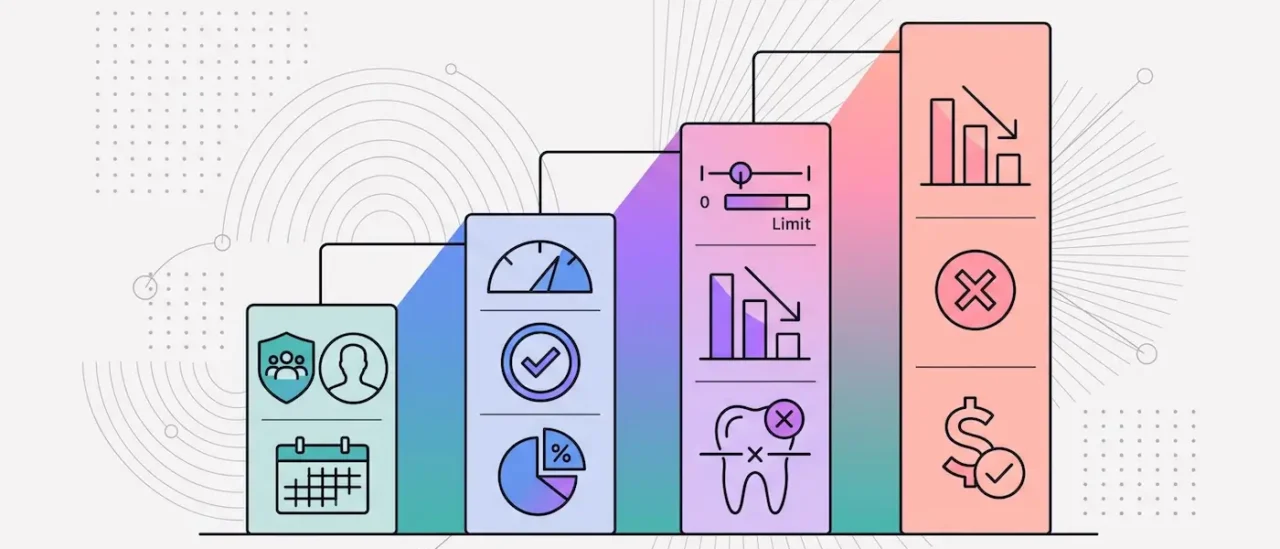
Dental insurance verification levels: Active, Plan, Code and Historical Payer Behavior
- Level 1: Active. Coverage is in force; plan, subscriber and effective dates match.
- Level 2: Plan. The annual maximum and what remains, the deductible and what’s met, and coverage percentages by category.
- Level 3: Code. Frequency limits, waiting periods, age limits, downgrades and alternate benefits, missing tooth clause, service history and pre-authorization requirements for the procedures on the schedule.
- Level 4: Historical payer behavior. How this payer has previously adjudicated similar procedures for this practice, based on your claims, EOBs, denials and appeals.
We call this the Verification Depth Ladder: Elva’s framework for comparing verification tools by the deepest level of benefit detail they reliably deliver. Clearinghouse-only checks often stop around Level 2, although the depth of the response varies by payer; that’s the gap the ADA describes. Portal and call-based workflows can reach Level 3 when the relevant payer data is available. Level 4 requires a tool that reads your own claim history, because plan documents describe coverage rules, not how a payer has adjudicated your claims. It is historical evidence, not a guarantee of how the payer will handle the next claim.
You can see the step from Level 2 to Level 3 inside a single product line. Henry Schein One positions Dentrix Eligibility Essentials on EDI data, then adds payer-portal detail such as frequency limitations, procedure-level coverage percentages and remaining benefits in Eligibility Pro.
What is insurance verification write-back?
Insurance verification write-back means verified benefit information is saved into the practice management system instead of staying in a separate dashboard or browser tab.
Verified results end up in one of four places, and the difference matters:
- Native: the verification runs inside the PMS itself, so results are already where estimates are built.
- Structured write-back: an outside tool fills specific PMS fields, such as remaining maximum, deductible and frequency limits.
- Chart document: a PDF or report is attached to the patient record, where a person still has to read it.
- External dashboard or API: results stay in the vendor’s interface or flow to your own systems.
Write-back is one of the key differences between verification as a separate task and verification embedded in the practice workflow. With structured fields, nobody retypes maximums or frequencies, and treatment plans and estimates use the verified numbers directly.
Ask every vendor to show write-back in your own PMS, field by field. Depth varies by system: some PMSs accept deep, structured updates from outside tools, while others limit what third parties can write, so the same product can behave differently on Dentrix, Open Dental or Eaglesoft.
What a complete verification report should show
A complete verification report tells you what the plan covers for the procedures you’re planning, where each answer came from, and what is still unknown. Use this list to judge any tool’s output, not just its feature page.
- Coverage status, plan, subscriber and effective dates
- Annual maximum and deductible, with how much of each is left
- Coverage percentages by service class, with the rules that apply
- Frequencies, age limits and waiting periods, and when each service is next due
- The payer’s own rules that change the estimate, such as a build-up bundled into a crown
- A patient estimate for the procedures on the schedule
- The source of each answer: electronic check, payer portal, payer manual, a call to the payer, or your own claim history
- A clear list of what the payer didn’t report, instead of a guess
- A dated reference you can cite if the claim is later denied
Here’s what that looks like in Elva’s Live Check, run for a new patient who called the office (demo data):
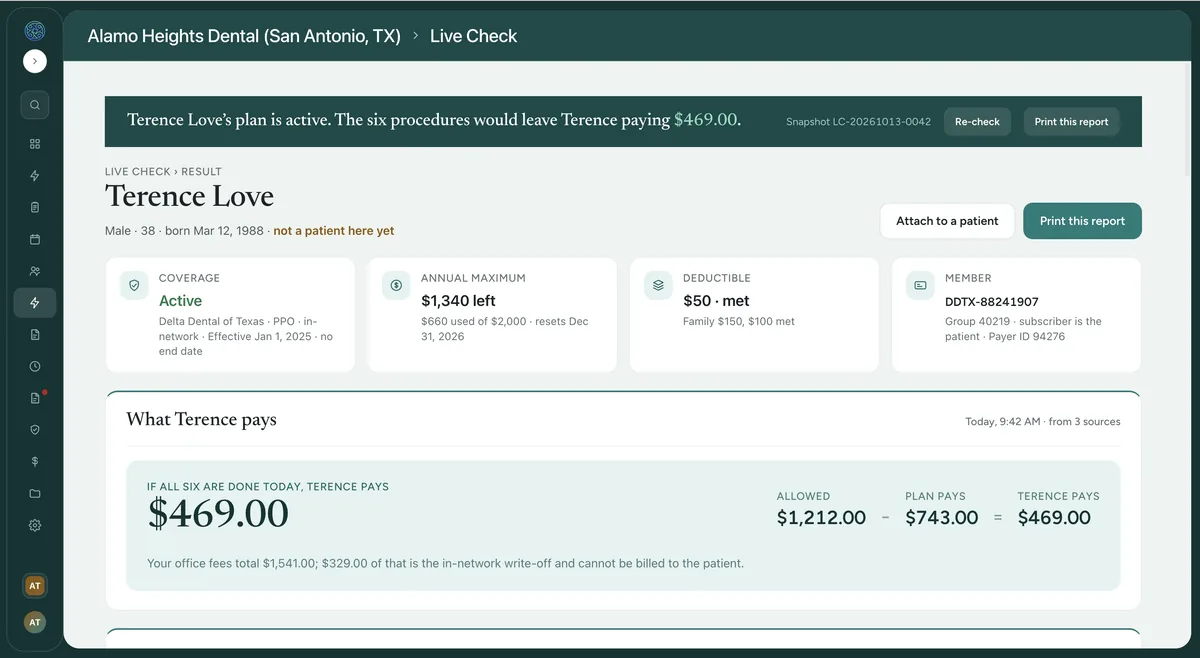
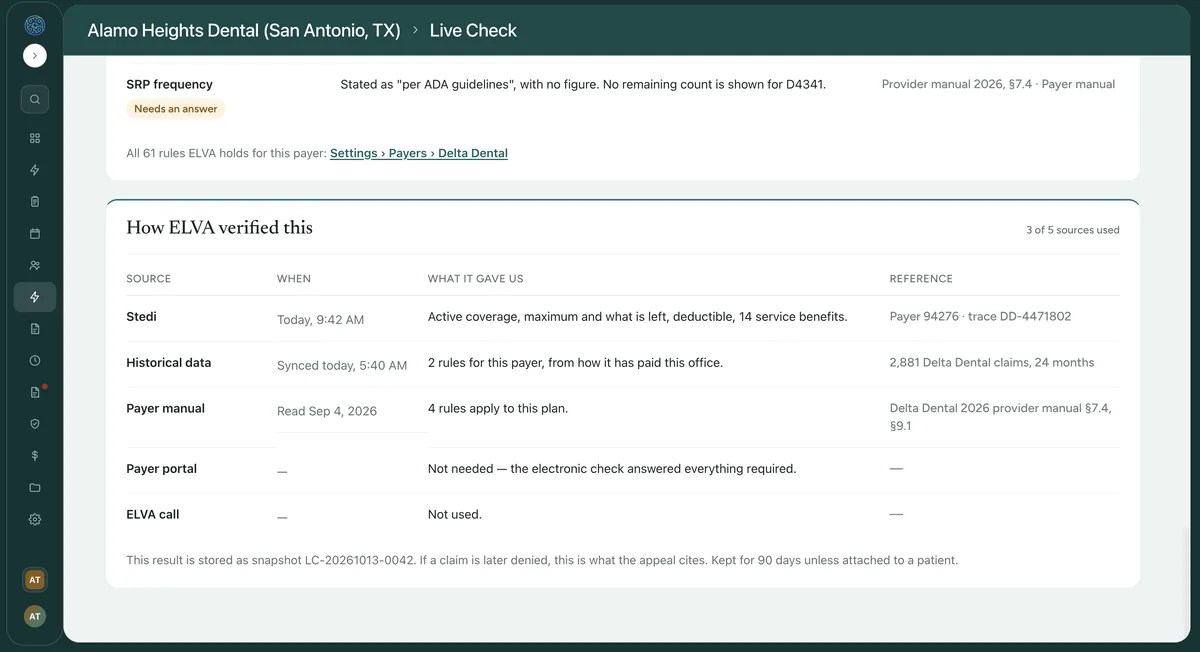
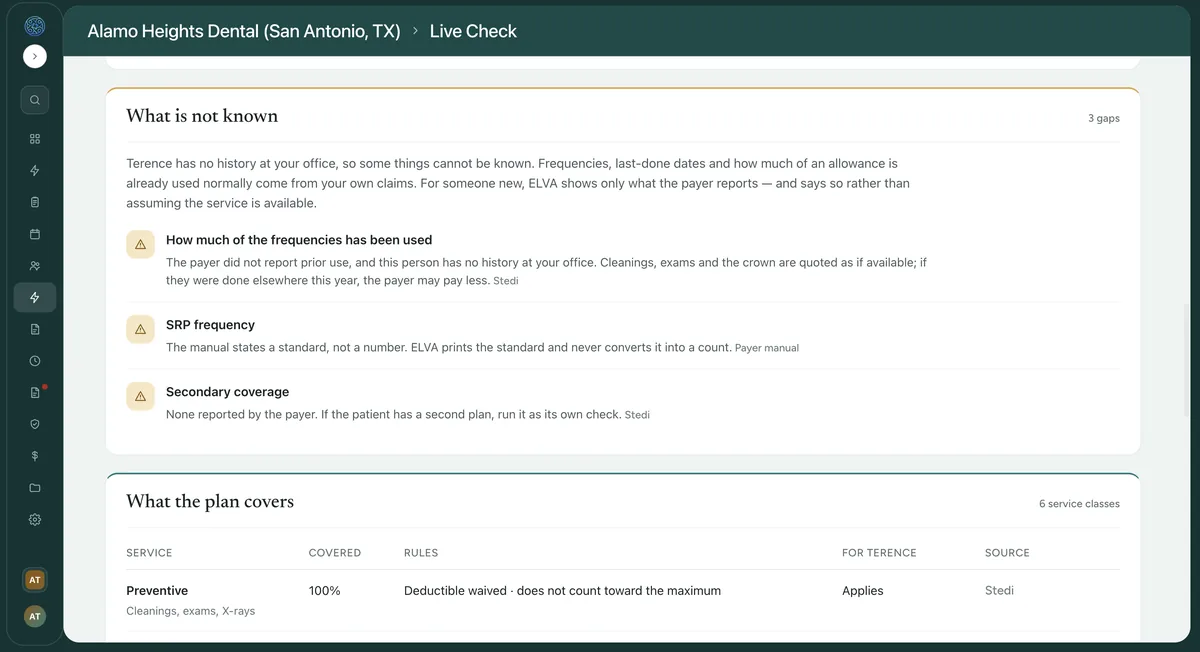
Most verification pages show the first two items. Items 7 to 9 are the ones that save a phone call later: they tell your team whether to trust a number or check it.
Software vs. outsourced dental insurance verification services
Choose software when your team can own the exceptions; choose an outsourced dental insurance verification service when nobody on staff can, and weigh its turnaround window against your same-day needs.
Services such as eAssist, Wisdom, Medusind, Dental Claim Support, Outsource Strategies International, Dentalogic and PracticeAlpha verify through portals and calls and deliver breakdowns ahead of the schedule. Dental Claim Support, for example, says it updates records three business days before appointments.
| Factor | Verification software | Outsourced verification service |
|---|---|---|
| Same-day patients and walk-ins | Real time or on demand | Depends on the turnaround window; rush requests may carry fees |
| Benefit depth | Set by the tool’s data sources (Level 2 to 4) | Often Level 3 when the service uses portals or phone verification; varies by provider |
| Where results land | Native, structured PMS fields, a chart document or a dashboard, depending on the tool | PMS fields or a PDF in the chart |
| Who chases incomplete answers | Your team, or the tool’s own payer calls | The service |
| Consistency across locations | Same logic at every office | Depends on the service’s staffing |
What to look for in dental insurance verification software
- Depth. Which verification level it reliably reaches. For practices that want estimates based on procedure-specific limitations, Level 3 is the more useful benchmark to test.
- Data sources. Which source fills each field: clearinghouse, portal, phone or claims history.
- Where results land. Native, structured write-back, a chart document or an external dashboard.
- Timing. At booking, days before the visit, and on demand for same-day patients.
- Exception handling. Who resolves an incomplete payer response, and how fast.
- Conflict handling. Whether it flags, overwrites or holds changes to data already in your PMS.
- Workflow beyond verification. Whether results flow into pre-authorization, estimates and claims.
- Historical payer behavior. Whether it can check answers against your own claims history.
How we evaluated the 15 tools
We evaluated every tool against the same eight criteria, using each vendor’s public documentation as of September 30, 2026, re-checked October 19, 2026.
We included products that provide dental insurance verification as a documented capability, whether as a stand-alone tool, inside a PMS or clearinghouse, or as a managed service, and prioritized the ones that appear most often in search results and AI answers for this category. Other products in the category include pVerify, mConsent, Yapi, VideaHealth AutoVerify and Toothy AI; we haven’t profiled them in this edition.
A tool receives a verification level only when its public documentation supports the capabilities behind it. Where only some Level 3 fields are documented, we mark it “2 (partial 3).” “Not documented” means we didn’t find the capability in the documentation we reviewed; it does not mean the product lacks it. We noted whether each vendor documents its pricing but didn’t compare prices, because most quote by volume or bundle verification into a broader subscription. We also didn’t declare an overall winner, because the right tool depends on your PMS, your size and your payer mix.
Dental insurance verification software comparison
The 15 tools differ most in where their data comes from and where the results land.
| Tool | How it verifies | Depth* | Where results land | Timing | Best fit |
|---|---|---|---|---|---|
| Elva | Real-time benefits (Stedi), portals, payer calls, payer manuals and claims history, with the source of each answer shown | 4 | Inside your PMS (read and write-back), plus a dated report that lists what’s unknown | At booking, before the visit, and on demand (Live Check) | Practices wanting verification inside their PMS, tied to claims and appeals |
| Dentrix Eligibility Pro | EDI (Essentials) plus payer portals (Pro) | 3 | Native to Dentrix and Dentrix Ascend | On demand | Dentrix and Dentrix Ascend offices |
| Curve Eligibility+ | Payer portals, compared against Curve records | 3 | Native to Curve, applied after staff approval | Days before or at the visit | Curve offices |
| CareStack | Electronic eligibility (EDI) | 2 (partial 3) | Native to CareStack | On demand, with due-date warnings | CareStack users |
| DentalXChange Eligibility AI | Payer websites, synced to the schedule | 3 | External dashboard; native in Denticon | 1–10 days before; real time for same-day | Clearinghouse customers, Denticon groups |
| Vyne Trellis | Electronic eligibility (EDI) | 2 | External dashboard (Trellis) | Batch or real time | Billing teams bundling eligibility with claims |
| Weave | Payer portals (Weave Insurance Eligibility) | 3 | Weave app; PDF reports in its document center; PMS write-back of results not documented | Automatic for scheduled patients | Offices already on Weave |
| Dental Intelligence | Not documented | 2 | Chart document (PDF) | Set days before; on demand | Dental Intelligence customers |
| Overjet | Direct payer feeds, portals and clearinghouses | 3 | Structured write-back (synced to the PMS) | 3+ days before; new patients on demand | Practices using Overjet’s clinical or RCM tools |
| Zuub | Direct payer connections, plus EDI where appropriate | 3 | REST API into your own systems | Not documented | DSOs and tech teams wanting normalized data |
| Needletail AI | Payer calls and portal data, human-reviewed | 3 | Verified form written into the PMS | Before the visit | Group practices and emerging DSOs |
| Stratus AI | AI calls to insurers, human-reviewed | 3 | Write-back to Open Dental, Eaglesoft and Dentrix | Instant checks; custom breakdowns days ahead | Offices whose payers still need calls |
| dentalrobot | 300+ payer portals, a call center, fax-backs and five clearinghouses | 3 | Dashboard or PMS (full write-back stated for 10+ systems) | Instant, scheduled or custom | Practices and DSOs |
| AirPay | Data exchanges and direct payer connections | 2 | AirPay dashboard; write-back not documented | Up to 7 days before; on demand for same-day | DSOs and private practices verifying the full schedule |
| iCoreVerify | Real-time benefits from payers; sources not documented | 2 (partial 3) | Stored in the PMS | Up to 7 days before; same-day on demand | Practices wanting volume-tiered pricing |
*Depth is our reading of public documentation on the Verification Depth Ladder, as of September 30, 2026, re-checked October 19, 2026. “2 (partial 3)” means some code-level fields are documented, but not their source or completeness. Level 4 is our category for tools that use a practice’s own historical claims, payment, denial or appeal data to inform verification; it does not guarantee how a payer will adjudicate a future claim. “Not documented” means we didn’t find it in the documentation we reviewed.
How to test verification software before you buy
Run every demo on your own upcoming patients, not the vendor’s sample data.
- Pick a week of upcoming appointments that includes your hardest payers.
- Compare each returned field against a manual portal check.
- Open those patients in your PMS and see exactly what wrote back, and where.
- Add a same-day patient and time the result.
- Choose a payer that often returns incomplete data and see who follows up, and how fast.
- Pick one procedure with a known limitation, such as a frequency rule, a downgrade or a waiting period, and compare the tool’s answer with the payer’s own source.
The gaps show up on your payer mix, not theirs.
The 15 dental insurance verification tools, profiled
Each profile opens with a one-line summary and uses the same fields. Elva comes first because it’s our platform (see the disclosure above); the rest run from verification built into your PMS to stand-alone specialists. The numbers are for navigation, not a ranking.
1. Elva
Elva is a connected dental insurance platform from Elva Health Technologies that verifies eligibility and benefits inside your own PMS (Dentrix, Dentrix Ascend, Open Dental, Eaglesoft, Curve, Denticon and CareStack), then carries the result into pre-authorization, claims and appeals.
How it verifies: Uses up to five sources and labels which one answered each item: real-time electronic eligibility (through Stedi), your practice’s own claim history (up to three years of claims, payments, denials, downgrades and appeals), payer rules read from payer manuals, payer portals, and outbound calls to the payer when the electronic answer is incomplete. In Elva data, 9 in 10 checks finish with no staff work.
Depth: Level 4 (historical payer behavior from your own claims data).
Results land: Inside your PMS. Elva reads from it and writes verified results back to it. Each check is also saved as a dated report that lists what is still unknown and can be cited in an appeal. Elva Chat answers code-level questions.
Timing: At booking, including Dental Online Booking, and again before the visit. Live Check runs on demand for walk-ins and callers who aren’t patients yet, and returns in about 20 seconds (median, Elva data).
Chrome extension: Elva is the only tool in this comparison with a Chrome extension. The front desk opens the eligibility report next to the PMS screen in one click, with no second login and no copying between tabs. In Elva data, that saves about 5 minutes per patient, roughly an hour a day at 12 patients.
Pricing: Not published; quotes on request within 24 hours.
Best fit: Practices and groups that want verification done inside their own PMS and connected to pre-authorization, claims and appeals.
Watch for: Elva is a broader platform than a single-purpose eligibility feed. If you only need raw eligibility data piped into your own software, an API-first vendor fits more directly. The historical layer sharpens as more of your claim history is connected. As with any tool, eligibility isn’t a guarantee of payment.
Source: Elva Eligibility Verification; Elva product data. Reviewed October 2026.
2. Dentrix Eligibility Pro
Dentrix Eligibility Pro is Henry Schein One’s insurance verification tool for Dentrix and Dentrix Ascend, adding payer-portal benefit detail on top of the EDI eligibility in Dentrix Eligibility Essentials.
How it verifies: EDI eligibility (Essentials) plus payer-portal data (Pro): patient history, frequency limitations, procedure-level coverage percentages, remaining benefits and network coverage. Dentrix’s page says Pro retrieves 100+ CDT codes.
Depth: Level 3 with Pro, where the payer supports it.
Results land: Native, inside Dentrix and Dentrix Ascend, filling deductibles, maximums and co-insurance into the coverage tables.
Timing: On demand from the eligibility page; automated scheduling not documented.
Pricing: Not documented.
Best fit: Dentrix and Dentrix Ascend offices that want verification without adding a vendor.
Watch for: Pro support varies by payer. Dentrix Ascend shows which payers support Essentials, Pro or both, so check your top payers first.
Source: Henry Schein One announcement, Sept. 2024; Dentrix Ascend payer-support note. Reviewed October 2026.
3. Curve Eligibility+
Curve Eligibility+ is the insurance verification feature built into Curve Dental’s cloud PMS, pulling code-level coverage from payer portals.
How it verifies: Logs into payer portals for real-time, code-level coverage. SmartSync compares the payer data with what’s already in Curve and flags mismatches.
Depth: Level 3.
Results land: Native, inside Curve, applied after staff approval.
Timing: Days before the appointment or at the visit, on a schedule the office controls.
Pricing: Unlimited eligibility is included in both Curve plans; prices not published.
Best fit: Curve offices that want code-level detail inside the system they already run.
Watch for: Available to Curve practices only. Updates wait for staff approval, so build the review into the daily routine.
Source:Curve Eligibility+. Reviewed October 2026.
4. CareStack
CareStack’s insurance verification module is part of the CareStack PMS, sending electronic eligibility requests from inside the patient record.
How it verifies: Electronic eligibility requests with responses in seconds, alongside fields for maximums, deductibles, coverage levels, exclusions and limitations, and alternative benefits.
Depth: 2 (partial 3). Some code-level fields are documented, but not whether the payer response fills them or your team does.
Results land: Native, inside CareStack, with a record of when eligibility was last checked.
Timing: On demand, with warnings when a check is due.
Pricing: Electronic eligibility is included in the Essentials plan, which starts at $829 a month; managed verification is available in the CareRevenue add-on.
Best fit: Offices and groups already running CareStack.
Watch for: Confirm which code-level fields fill automatically for your payer mix.
Source:CareStack insurance verification. Reviewed October 2026.
5. DentalXChange Eligibility AI
DentalXChange Eligibility AI is a verification product from the DentalXChange clearinghouse that pulls benefits from payer websites into one dashboard, synced with the practice schedule.
How it verifies: Pulls benefits from payer websites, organized the same way across payers, with an exception-based workflow.
Depth: Level 3.
Results land: External dashboard; native inside Denticon through AutoEligibility.
Timing: Automatically one to ten days before the appointment, or in real time for same-day patients.
Pricing: Not documented.
Best fit: DentalXChange clearinghouse customers and Denticon groups.
Watch for: Outside Denticon, ask exactly what writes back into your PMS.
Source:DentalXChange Eligibility AI; Planet DDS AutoEligibility. Reviewed October 2026.
6. Vyne Trellis
Vyne Trellis is Vyne Dental’s web-based billing and clearinghouse platform, with batch and real-time eligibility next to claims and attachments.
How it verifies: Batch and real-time electronic eligibility.
Depth: Level 2.
Results land: External dashboard (the Trellis web platform), next to claims, attachments, ERAs and claim status.
Timing: Batch or real time.
Pricing: Eligibility is included in one monthly unlimited service fee; the amount isn’t published.
Best fit: Billing teams that want eligibility, claims and attachments in one workspace.
Watch for: Electronic eligibility is only as deep as the payer’s response, so plan portal or phone follow-up for code-level gaps.
Source:Vyne Trellis announcement. Reviewed October 2026.
7. Weave
Weave offers insurance verification inside its patient communication platform, and its Insurance Eligibility feature reads payer portals directly.
How it verifies: Reads payer portals directly for details EDI often omits, such as procedure history, code-specific information and frequency limits.
Depth: Level 3 with Weave Insurance Eligibility; the depth of Weave’s original verification product isn’t documented.
Results land: The Weave app, with eligibility reports saved as PDFs in its document center; write-back of results to the PMS isn’t documented.
Timing: Automatic for scheduled patients.
Pricing: Verification isn’t shown in Weave’s published plans.
Best fit: Offices already on Weave that want verification next to texting and scheduling.
Watch for: Confirm which Weave verification product your subscription includes and which PMS fields it updates.
Source:Weave Insurance Eligibility; Weave Insurance Verification. Reviewed October 2026.
8. Dental Intelligence
Dental Intelligence offers Automated Verification as part of its analytics and patient-engagement software, checking scheduled patients before their visits.
How it verifies: Automated eligibility checks using the insurance on file in your PMS; data sources not documented.
Depth: Level 2; deeper fields not documented.
Results land: Chart document: a PDF breakdown saved to the patient’s chart.
Timing: A set number of days before appointments, plus individual or bulk checks on demand.
Pricing: Requires both the Insurance and Engagement modules; prices not documented.
Best fit: Dental Intelligence customers.
Watch for: A PDF is readable, not structured, so someone still carries the numbers into estimates. Automated checks cover primary insurance only.
Source:Dental Intelligence Automated Verification. Reviewed October 2026.
9. Overjet
Overjet, a dental AI company known for FDA-cleared imaging AI, offers insurance verification as part of a revenue cycle suite that also covers estimates and claims.
How it verifies: Direct data feeds from payers plus automated retrieval from payer portals and clearinghouses. Overjet’s pages state coverage of 300+ and 1,000+ payers.
Depth: Level 3, including frequency limits, age restrictions, downgrades, service history and missing tooth clauses.
Results land: Structured write-back, synced with major PMSs.
Timing: Automatically 3+ days before the appointment, with new patients verified on demand.
Pricing: Not documented.
Best fit: Practices already using Overjet’s clinical AI, or groups consolidating verification, estimates and claims with one vendor.
Watch for: Ask who follows up when a portal or feed doesn’t return a benefit, and how incomplete responses reach your team.
Source:Overjet Insurance Verification. Reviewed October 2026.
10. Zuub
Zuub is a dental insurance verification company built for DSOs and technology platforms, delivering normalized eligibility data by API.
How it verifies: Direct payer connections (PayerDirect), alongside EDI where appropriate, with every payer’s response normalized into one standardized format.
Depth: Level 3.
Results land: A REST API that delivers the data into your own systems; PMS write-back isn’t documented.
Timing: Not documented.
Pricing: Not documented.
Best fit: DSOs and technology teams that want standardized eligibility data feeding their own systems.
Watch for: With an API-first design, your PMS integration or internal systems handle the last mile. Confirm write-back depth for each PMS you run.
Source: Zuub announcement, Sept. 2025. Reviewed October 2026.
11. Needletail AI
Needletail AI is a managed dental insurance verification service for group practices and DSOs, combining AI agents with human review.
How it verifies: AI agents call payers and parse portal data; trained verification specialists review the work.
Depth: Level 3.
Results land: A verified form written into the PMS. Listed integrations include CareStack, Dentrix Ascend, Open Dental, Eaglesoft and Curve.
Timing: Before the visit.
Pricing: Not documented.
Best fit: Group practices and emerging DSOs that want verification handled as a service.
Watch for: Human review adds accuracy and a turnaround window. Ask how same-day additions and walk-ins are handled.
Source:Needletail AI company description. Reviewed September 2026.
12. Stratus AI
Stratus AI is a dental insurance verification company that uses voice AI to call insurers and build benefit breakdowns.
How it verifies: Voice technology calls insurers and assembles customizable benefit breakdowns. Reports were reviewed by a person before delivery, as described at launch.
Depth: Level 3.
Results land: Write-back to Open Dental, Eaglesoft and Dentrix, per Stratus AI’s website.
Timing: Instant eligibility checks; custom breakdowns can be requested days or weeks ahead.
Pricing: Not documented.
Best fit: Offices whose payer mix still requires phone calls for a full breakdown.
Watch for: Ask which PMS fields receive structured write-back and how long a typical breakdown takes.
Source:Stratus AI; launch coverage. Reviewed October 2026.
13. dentalrobot
dentalrobot is a dental insurance verification automation company for dental practices and DSOs.
How it verifies: Checks 300+ payer portals and uses a call center, fax-backs and five clearinghouses to read, extract and validate eligibility and full-breakdown data.
Depth: Level 3.
Results land: The dentalrobot dashboard or your PMS; dentalrobot states full write-back for 10+ dental software brands without naming them.
Timing: Instant, scheduled and custom checks.
Pricing: From $150 per location per month.
Best fit: Practices and DSOs standardizing verification across offices.
Watch for: Ask which PMSs receive full write-back; the website doesn’t name them.
Source:dentalrobot. Reviewed October 2026.
14. AirPay
AirPay is a dental insurance verification product from Smylen Inc. that checks eligibility for a practice’s whole schedule, for DSOs and private practices.
How it verifies: Pulls appointments from the PMS and verifies them through data exchanges and direct payer connections; AirPay states coverage of 1,200+ carriers. A separate Call Center product gives booking agents real-time eligibility checks.
Depth: Level 2. AirPay describes detailed plan breakdowns and warnings drawn from eligibility data and treatment history; code-level fields are not documented.
Results land: An AirPay dashboard; PMS updates are described in general terms, and write-back fields and supported PMSs are not documented.
Timing: Scheduled up to seven days ahead, plus on-demand checks for new and same-day appointments.
Pricing: A flat monthly rate; amounts not published.
Best fit: DSOs, private practices and central billing or call-center teams that want the full schedule verified automatically.
Watch for: Ask which code-level fields AirPay returns, which PMS fields it updates, and whether it calls payers when electronic data falls short.
Source: AirPay website (home, Private Practice, DSO, Warnings and Call Center pages). Reviewed October 2026.
15. iCoreVerify
iCoreVerify is iCoreConnect’s automated dental insurance verification product, priced in monthly volume tiers for solo practices through multi-location DSOs.
How it verifies: Retrieves real-time benefits directly from payers in place of phone calls and portal logins; specific data sources are not documented.
Depth: 2 (partial 3). Coverage details, frequencies, deductibles and maximums are documented; benefit history and waiting periods are not.
Results land: Stored in the PMS without manual entry, with coverage types mapped to the practice’s PMS templates; supported PMSs are not documented.
Timing: Checks every scheduled patient up to seven days before the appointment, and same-day appointments on demand.
Pricing: Published in monthly volume tiers, from $450 a month for up to 50 verifications to $1,250 a month for up to 250, with custom pricing above that (per iCoreConnect’s website, October 2026).
Best fit: Practices that want verification priced by monthly volume, with a choice of a done-for-you or do-it-yourself service.
Watch for: Confirm which PMSs and payers are supported. Patients who have restricted digital access to their health information are flagged for manual follow-up.
Source: iCoreConnect Verification of Benefits page. Reviewed October 2026.
Where Elva goes beyond verification
Elva also covers the insurance work that follows verification: pre-authorization, claims, follow-up and appeals.
- Pre-authorization: flags dental pre authorization needs and the documentation a payer requires, before the visit.
- Claims: prepares claims with narratives and attachments and submits them through your existing workflow (how claim automation works).
- Follow-up: monitors claim status and handles dental claim follow up on aging accounts receivable through portals and payer calls.
- Appeals: builds appeals for denied or downgraded claims from payer rules, clinical documentation and past outcomes.
For the front desk, the Chrome extension puts the eligibility report next to the PMS screen in one click, so a check doesn’t mean a second login or copying numbers between tabs. Elva practices report about 40% fewer eligibility-related denials after switching (Elva data, October 2026).
Practices can start with verification and write-back, or run the full cycle with Elva’s Autonomous Insurance RCM. Staff can ask Elva Chat questions like “Is D2391 covered on tooth #30?” or “Does this need pre-auth?” and handle the exceptions Elva surfaces. Elva is HIPAA compliant, signs a BAA with every practice, and encrypts data at rest and in transit.
Which dental insurance verification software fits your practice?
Start from your PMS and your size, then test the shortlist on your own patients.
- On Dentrix or Dentrix Ascend: start with Dentrix Eligibility Pro, and check Pro support for your top payers.
- On Curve: start with Curve Eligibility+.
- On CareStack: start with the built-in module, and add a specialist if code-level gaps remain.
- On Open Dental or Eaglesoft: evaluate stand-alone tools with structured write-back, such as Overjet, Zuub, Needletail AI or Elva.
- Need eligibility data for your own systems: evaluate API-first platforms such as Zuub.
- Payers that still need phone calls: consider tools that place payer calls, such as Stratus AI, Needletail AI or Elva.
- Want verification handled for you: consider Needletail AI or an outsourced verification service.
- Mixed PMSs across locations: look for a PMS-independent option such as Zuub, Needletail AI or Elva.
- Want the whole schedule checked days ahead, priced by volume: consider AirPay or iCoreVerify.
- Want verification connected to claims: consider connected platforms such as Overjet (estimates and claims) or Elva (through follow-up and appeals, checked against your claims history).
See how your own patients verify
Run a sample of upcoming patients through Elva and see what gets verified, what gets flagged, and what writes back into your PMS.
Book a demo → · Add the Chrome extension
Comparing phone coverage too? See our guide to the Best AI Receptionist for Dental Offices.
Frequently asked questions
What is the best dental insurance verification software?
There isn’t one best dental insurance verification software for every practice. The right choice depends on the verification depth you need, your PMS, your payer mix, turnaround requirements and where results need to land. Modules built into the PMS (Dentrix Eligibility Pro, Curve Eligibility+, CareStack) are the simplest start. Overjet, Zuub, Needletail AI and Stratus AI retrieve code-level detail through payer feeds, portals or calls. Elva adds historical payer-behavior checks from your claims data and carries results into pre-authorization, claims and appeals.
What’s the difference between dental insurance verification and eligibility verification?
Eligibility verification is one step within dental insurance verification. It confirms the patient’s coverage is active, while full insurance verification also retrieves plan benefits, remaining maximums, deductibles and code-level limits such as frequencies, waiting periods and downgrades.
Does dental insurance verification software verify benefits by procedure code?
Some tools do. Code-level verification (Level 3 on the Verification Depth Ladder) covers frequency limits, waiting periods, age limits, downgrades, missing tooth clauses and service history for specific procedures. Tools that rely only on electronic eligibility responses often can’t return this reliably, so ask each vendor which procedure-level fields it retrieves and from which source.
How do dental offices verify insurance?
Most offices verify through three channels: an electronic eligibility check through their clearinghouse or PMS, the payer’s online portal, and a phone call to the insurer when the first two come up short. Automated dental insurance verification software runs one or more of those channels before the patient arrives.
How long does it take to verify dental insurance?
It depends on the channel. An electronic check returns in seconds, a portal lookup takes a coordinator minutes per patient, and a payer call can run far longer once hold times stack up. Done by hand across those channels, a full verification takes about 15 minutes of staff time; with Elva it takes under a minute, and a Live Check returns in about 20 seconds (Elva data, October 2026). Automated tools move that work ahead of the schedule, so your team only touches the exceptions.
How far in advance should a dental office verify insurance?
Verify when the appointment is booked and again a few days before the visit, because coverage can change in between. Check same-day additions on the day. Elva runs both checks automatically, at booking and before the visit.
How much does dental insurance verification software cost?
Pricing depends on verification volume, the number of locations, the PMS integrations involved, and whether the service includes human or call-based verification. Many vendors don’t publish prices, and some bundle verification into a broader PMS or platform subscription, so request quotes based on your actual monthly verification volume. A few vendors publish prices: CareStack includes electronic eligibility in its Essentials plan, starting at $829 a month; dentalrobot starts at $150 per location per month; and iCoreVerify is priced by volume, from $450 a month for up to 50 verifications. Most others quote on request.
Is there free dental insurance verification software?
Payer portals and many PMS eligibility checks cost nothing extra to use, but they leave the work with your team: logging in, reading the benefits and typing them into the chart. Software that automates the full breakdown and writes it back to your PMS is paid, usually by location or by verification volume.
Does dental insurance verification software work with Dentrix and Open Dental?
Many tools in this guide support both, but write-back depth varies by PMS. On Dentrix and Dentrix Ascend, Henry Schein One offers native options in Eligibility Essentials and Eligibility Pro. For Open Dental, stand-alone tools such as Overjet, Zuub, Needletail AI and Elva list integrations. Ask each vendor to show write-back in your own system.
Can verification software handle same-day patients and walk-ins?
Yes, if it verifies on demand as well as on a schedule. DentalXChange Eligibility AI, Curve Eligibility+, Overjet and Elva all document same-day or on-demand checks, while batch-only and call-based tools need more lead time. Elva’s Live Check also verifies people who aren’t patients yet, such as a caller asking whether you take their plan. Test a same-day add during the demo.
Can AI verify dental insurance?
Yes. AI dental insurance verification tools read payer portals, normalize responses from different payers into one format, and in some cases call payers by voice. The practical questions are which sources the AI uses, whether a person reviews exceptions, and whether results write back into your PMS as structured data.