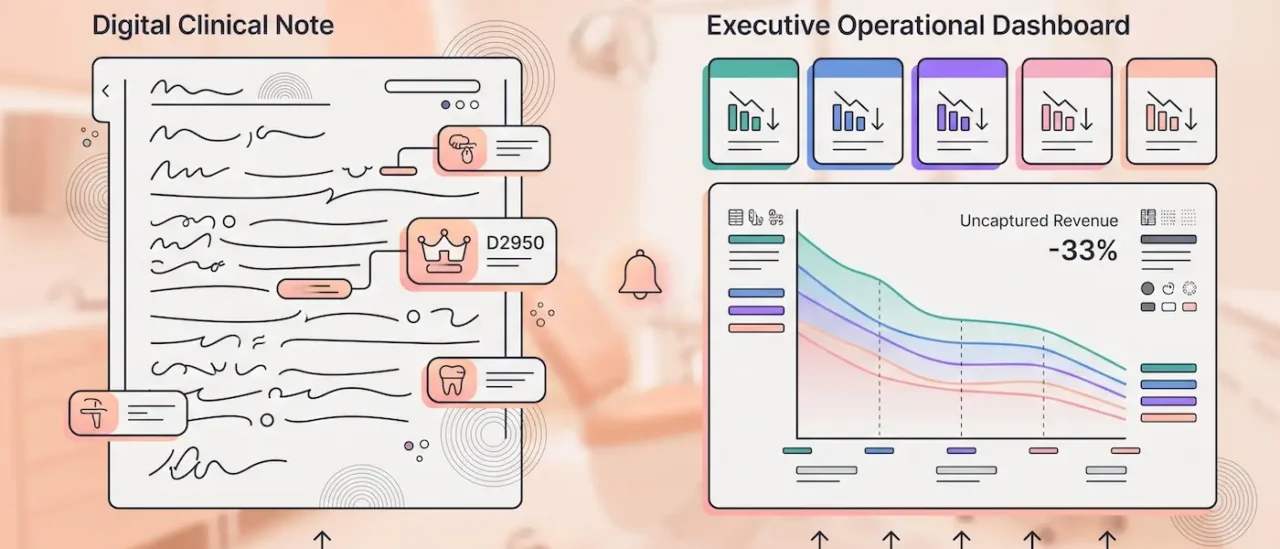
When an emerging dental group crosses the 5-location mark, a hidden margin leak begins to erode profitability: associate coding variance. As founders step away from the chair and begin hiring non-owner associate dentists, clinical documentation and coding consistency inevitably fractures.
Many associate dentists habitually undercode procedures because they fear aggressive insurance audits, lack training on specialized CDT updates, or are simply rushing to keep up with a packed schedule. The result is millions of dollars in justifiable adjunctive procedures, build-ups, and specialized evaluations that are performed chairside but never successfully billed to the payer. The traditional industry solution for this—retroactive dental chart auditing—is fundamentally broken. It is too slow, too labor-intensive, and relies on human memory days after the patient has already left the building.
This is where dental clinical coding automation fundamentally transforms multi-location group operations. By utilizing artificial intelligence to catch missing or conflicting codes while the patient is still sitting in the operatory, scaling practices can close the associate coding gap entirely and instantly recapture their rightful margin.
The Compounding Financial Impact of Under-Coded Dental Procedures
In a multi-location group, a single associate forgetting to bill a justifiable code has a compounding, enterprise-wide effect. If an associate sees fifteen patients a day and omits a $120 adjunctive code just twice a day, that single provider is leaking over $50,000 in baseline EBITDA annually. Multiply that across ten or twenty providers, and the financial damage is staggering.
The most frequently under-coded dental procedures across expanding dental groups include:
- D0180 (Comprehensive Periodontal Evaluation): Frequently miscoded as a standard D0120 periodic exam. Dentists perform the extensive periodontal probing and risk assessment, but default to the familiar D0120 out of habit, leaving higher reimbursement rates on the table.
- D2950 (Core Build-Up, Including Any Pins): Often performed during complex crown preparations but left off the billing router due to chairside time constraints or the assumption that the crown code covers the entire prep.
- D9223 / D9243 (General Anesthesia / IV Sedation): Additional 15-minute time increments that are accurately documented in clinical anesthesia logs but fail to cross over to the final billing ledger.
- D0431 / D0480 (Adjunctive Diagnostic Testing): Specialty oral cancer screenings or mucosal evaluations performed chairside that the clinician forgets to mention to the front desk.
This is a classic example of unbilled care silently draining your valuation. When scaling, operations leaders must ensure every provider bills precisely for the work they actually perform. Accurate coding not only maximizes legitimate reimbursement but also establishes trust, clean data, and predictable forecasting in your overall dental revenue cycle management.
Why Manual Oversight Fails at Scale
Relying on a Central Billing Office (CBO) to spot clinical discrepancies is a losing battle. Billers are administrative experts, not clinicians; they only see what the doctor submits on the routing slip. If the doctor omits a code, the biller has no way of knowing the procedure ever took place.
When billers do catch a discrepancy, the correction workflow is agonizing. The biller sends the incomplete note back to the dentist. The dentist, now busy with a new patient, ignores the message until the end of the week. By the time the code is corrected, cash flow is delayed by weeks. Dental clinical coding automation eliminates this lag by shifting the intervention to the exact moment of care.
The Associate Coding Audit Matrix
| Evaluation Metric | Manual End-of-Day Audits | AI-Powered Coding Automation |
|---|---|---|
| Detection Timing | Retroactive (Days after patient leaves) | Real-time (While patient is in the chair) |
| Correction Workflow | Biller sends incomplete notes back to the dentist | System silently prompts dentist to add missing codes |
| Margin Leakage | High (Omitted codes are usually written off) | Zero (All performed services are instantly captured) |
| Associate Experience | Frustrating (End-of-day administrative backlog) | Invisible (Assists seamlessly in the background) |
| Compliance Risk | Moderate (Relies on exhausted human memory) | Low (AI enforces exact documentation requirements) |
Standardizing Dental Associate Production Across Clinics
Without centralized technology, dental associate production is heavily dependent on a provider’s individual administrative habits. You might have one associate who meticulously documents every single medicament and desensitizer, while another rushes to the next hygiene check and leaves easily justifiable revenue undocumented.
By deploying ambient dental AI, clinical directors can standardize production metrics across an unlimited number of locations. The system actively listens to the ambient operatory conversation, cross-references the spoken clinical diagnoses against the proposed treatment plan, and flags discrepancies before the patient even reaches the front desk. This levels the playing field, ensuring that every associate produces and bills at the exact same high standard of operational excellence.
Ensuring Bulletproof CDT Coding Compliance
A major reason associates undercode is the burden of proof. If a complex procedure is billed, the dental clinical notes must perfectly support medical necessity. If the documentation is vague or missing key clinical indicators, the claim is denied, or worse, it triggers a painful retrospective payer audit.
AI-driven coding acts as a real-time compliance firewall. If an associate attempts an automated dental claim submission for an extraction and bone graft, but the notes lack the required radiographic narrative or periodontal charting, the system intervenes immediately. It prompts the provider to complete the necessary narrative while the details are still fresh in their mind. This guarantees strict CDT coding compliance without forcing regional clinical directors to manually review hundreds of charts per week.
The Architecture for Uncapped Enterprise Growth
To scale confidently past the 5-location wall, emerging groups cannot rely on hiring armies of billers to catch clinical mistakes. The margin leak must be fixed at the source: the operatory itself.
Implementing intelligent dental DSO software that connects ambient clinical documentation directly to your revenue cycle ensures that every location, every associate, and every procedure is standardized. By removing the friction of manual code hunting, you allow your doctors to focus entirely on patient care, while the platform works silently in the background to protect your compliance, capture your revenue, and drive enterprise growth.